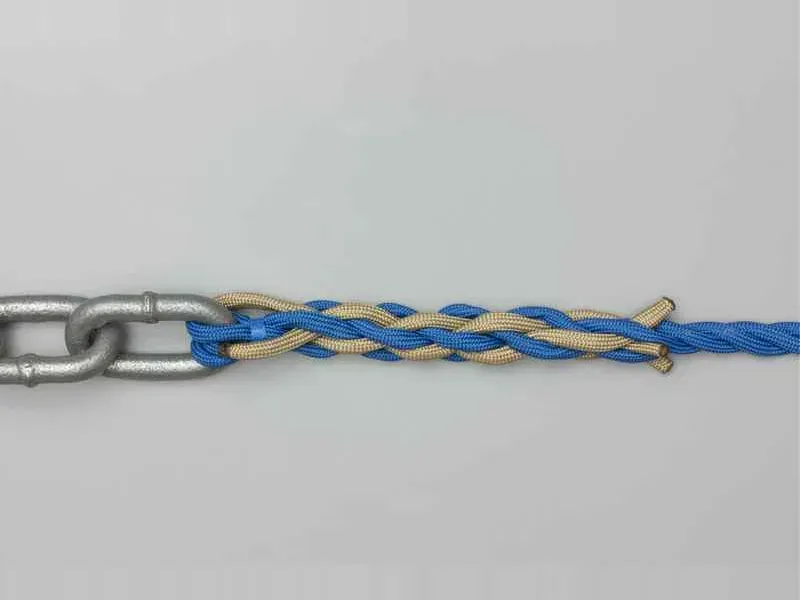
Splices three-strand rope straight into the last link of a chain without a shackle or thimble; the slim joint lets an anchor rode of rope and chain run together over a windlass and down into the chain locker.
Measure off enough rope from its end, bind it at that point with tape or tight twine, unlay the strands back to the binding and tape each strand's tip.
Lay the strands out flat side by side and pass the middle one through the chain's final link in one direction.
Take the other two strands through that link the opposite way, one on each side of the middle strand.
Tuck each strand into the standing part against the lay, OVER one strand and UNDER the next; after this first round, each of the three should emerge at the same height on the rope, each from a different gap.
After the first round of tucks, remove the wrapping and pull the strands up so the splice sits against the link while the link stays free on the rope.
Carry on tucking the same way, always against the lay, for five to seven rounds in all.
Cut the strand ends, leaving about one strand's thickness standing out where they leave the rope.
Joining rope to the end of a chain with a joint slim enough to pass through a block, fairlead or windlass.
When
Unknown; the earliest of the sources consulted is Aldridge's book of 1918.
Who devised it
Unknown.
Its story
Aldridge's 1918 seamanship book describes the chain splice for joining hemp tails to chain when they have to run through a block or fairlead, giving the earrings and outhauls of forecastle and quarterdeck awnings as examples. Dana and Pearl (1921) likewise mention it for splicing rope into a chain end that must travel through a block or a small opening. Today it is used mostly where an anchor rode changes from chain to rope: Animated Knots says it earns its place when a rope that follows the chain runs over a windlass and drops into the chain locker, and Good Old Boat magazine observes that the windlass goes from a loud clanking to a soft hum once the rope takes over, and that this change of sound marks a change of strength.
Where the joint never has to pass a windlass or block: according to Good Old Boat, a thimbled eye splice with a shackle is perfectly safe there and only has trouble getting through a windlass; the method the sources describe is for three-strand rope.
Weakness
It is exposed to chafe at the link and to heavy loads; inspect it often if it sees frequent use and, once it shows wear, cut it off and splice it again a little higher up the rope; seated too tight on the link it can jam in the windlass.