Binding
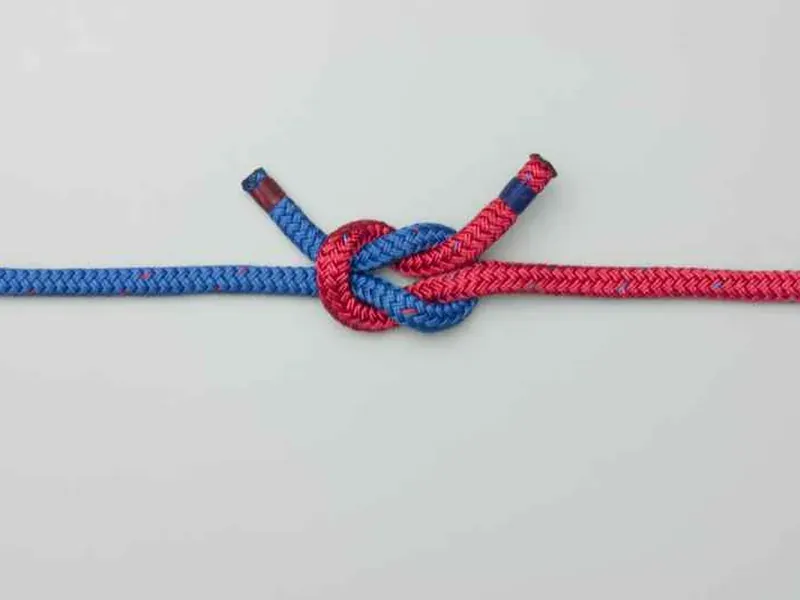
Reef knot (square knot)
Turkish: Camadan bağı
Ties the two ends of the same rope around something: a bag mouth, a bandage, a reefed sail.
How to tie it
- The other rope lies as a bight: its standing part on the left, its short end on the right. Pass the working end UNDER the bottom of the bight and up through it.
- Bring the working end out OVER the left leg, then take it round BEHIND (under) both legs to the right.
- Bring the end OVER the right leg (the short end) into the bight and down beside its own standing part, UNDER the bottom of the bight.
- Pull the standing parts to tighten. Both short ends lie on the same side, parallel to their standing parts.
The method was checked against: MEB MEGEP, Gemici Bağları modülü (2014), s. 10, Boğaziçi Üniversitesi Yelken, Düğüm-1 ders notu (2024), A. Hyatt Verrill, Knots, Splices and Rope Work (1917), Bölüm II.
Turkish names, by who uses them
- Seafarers: Camadan bağı
- Sailors: Camadan
- Fishers: Camadan düğümü
- Climbers: Camadan düğümü
- Scouts: Camadan bağı
- General use: Camadan düğümü
Other English names: Square knot, Hercules knot, Double knot, brotherhood knot, knot of Hercules
Main Turkish name from seafarers · Sahil Güvenlik, KÜRE (Deniz Harp Okulu), MEB, Denizcilik Müsteşarlığı, proje sahibi
Sources for the names
- Sahil Güvenlik Komutanlığı, "Gemici Bağları"
- KÜRE Ansiklopedisi, "Gemici Bağları" (MSÜ Deniz Harp Okulu "Denizcilik Köşesi", Sahil Güvenlik ve MEB'e dayanır)
- MEB MEGEP, Denizcilik: Gemici Bağları modülü (2014)
- T.C. Başbakanlık Denizcilik Müsteşarlığı, Denizcinin El Kitabı (2010)
- Proje sahibinin listesi
- Boğaziçi Üniversitesi Yelken, "Düğüm-1" ve "Düğüm-2" ders notları (2024)
- MEB MEGEP, Denizcilik: Ağ Bakımı ve Onarımı modülü (2016)
- Y. Güngör, Dağcılık, İstanbul Üniversitesi AUZEF ders kitabı
- Sakarya İzcileri, "İzci düğümleri: Gemici bağları"
- TÜBİTAK Bilim Çocuk, Temmuz 2019 eki "Düğümler"
- AFAD, "İpli Kurtarma Hazırlayıcı Eğitimi" (2025)
- Boğaziçi Üniversitesi Yelken Takımı, "Temel Yelkencilik Eğitim Kitabı"
- Where not to use it
- To join two separate ropes; it slips and opens under load.
- Weakness
- Dangerous as a bend; it capsizes when one end is pulled.
Similar and alternative knots
Sources and verification
- Wikipedia: Reef knot
- Wikidata: Q378077
- The tying steps were played in the rope engine to produce the checking signature; the comparison with two independent sources is in docs/pilot-baglar.md.