Bend
Fisherman's knot
Turkish: Balıkçı bağı
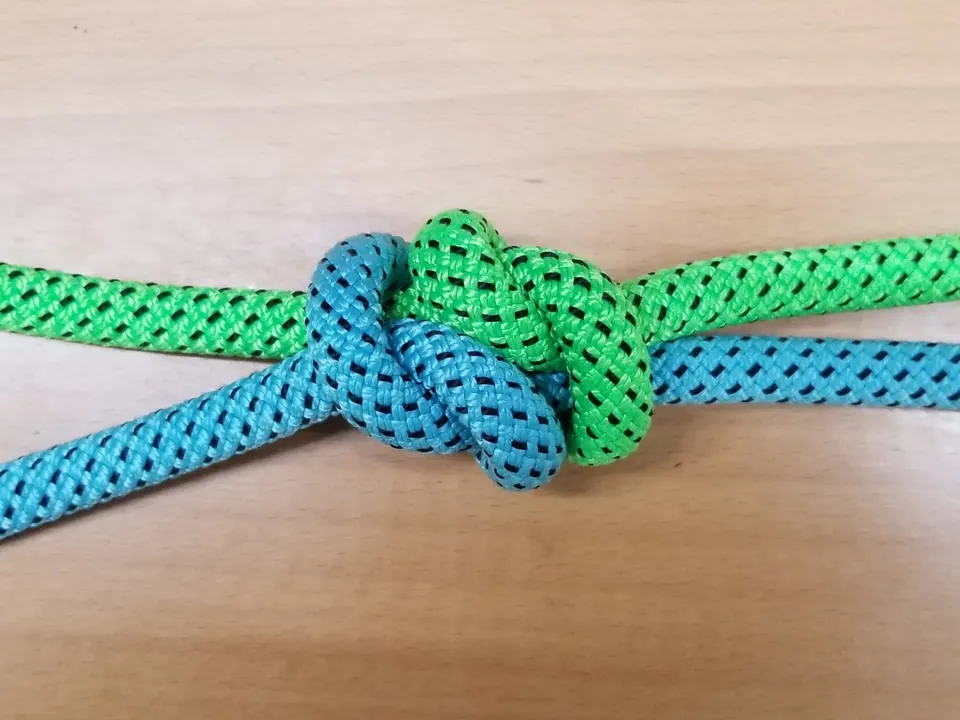
Joins two thin lines, each end tying an overhand knot around the other line.
How to tie it
- Lay the two ropes side by side, ends overlapping, pointing opposite ways. Take the first working end along the other rope.
- Wrap the other rope: take the end OVER it and back UNDER it.
- Bring the end OVER its own standing part to make a loop around the other rope.
- Tuck the end into the loop UNDER its own part and out OVER the outer side: an overhand knot around the other rope, tail pointing away from the other knot.
- Now do the same with the second working end: take it along the first rope.
- Wrap the first rope with the second end: OVER it and back UNDER.
- Bring the second end OVER its own standing part to make a loop.
- Tuck it into the loop UNDER its own part and out OVER the side.
- Tighten each knot, then pull the standing parts apart so the knots seat against each other.
The method was checked against: NetKnots: Fisherman's Knot, Boğaziçi Üniversitesi Yelken Takımı, "Temel Yelkencilik Eğitim Kitabı", s. 48.
Turkish names, by who uses them
- Seafarers: Balıkçı bağı
- Sailors: Balıkçı düğümü
- Climbers: Tek balıkçı düğümü, Balıkçı düğümü
Other English names: Waterman's knot, Angler's knot, (double) Englishman's knot, True lover's knot
Main Turkish name from seafarers · Sahil Güvenlik, KÜRE (Deniz Harp Okulu)
Sources for the names
- Sahil Güvenlik Komutanlığı, "Gemici Bağları"
- KÜRE Ansiklopedisi, "Gemici Bağları" (MSÜ Deniz Harp Okulu "Denizcilik Köşesi", Sahil Güvenlik ve MEB'e dayanır)
- Y. Güngör, Dağcılık, İstanbul Üniversitesi AUZEF ders kitabı
- AFAD, "İpli Kurtarma Hazırlayıcı Eğitimi" (2025)
- Boğaziçi Üniversitesi Yelken Takımı, "Temel Yelkencilik Eğitim Kitabı"
- Where not to use it
- In life-safety work such as climbing or lifting (use the double fisherman's).
- Weakness
- Very hard to untie after loading.
Similar and alternative knots
Sources and verification
- Wikipedia: Fisherman's knot
- Wikidata: Q1364501
- The tying steps were played in the rope engine to produce the checking signature; the comparison with two independent sources is in docs/pilot-baglar.md.