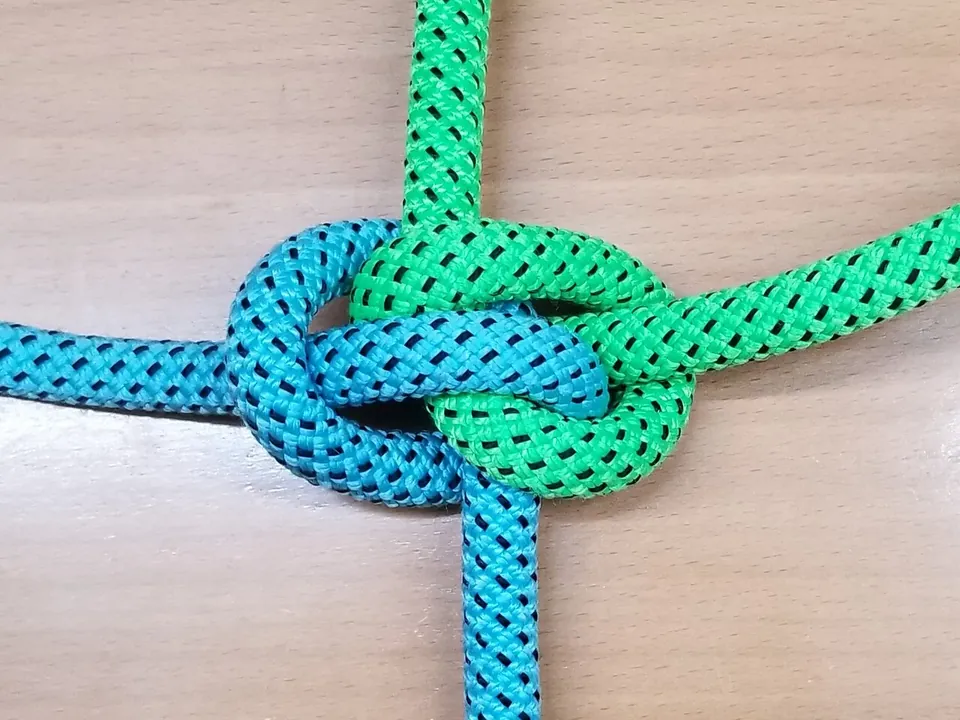
Bend
Zeppelin bend
Turkish: Zeppelin bağı
Joins two ropes of similar thickness and unties easily even after heavy loading.
How to tie it
- The other rope lies as a "9": its end crosses OVER its standing part and points down. Make a "6" with your rope, laying its loop OVER the 9's loop.
- Turn the end left, pass it UNDER its own standing part and bring it up: the 6 is done.
- Pass the 6's end down through the middle of both loops: in UNDER the 9's loop and its own, out OVER both.
- Now the 9's end goes the opposite way: up through the middle, OVER both loops, then out UNDER both; the two ends pass side by side in opposite directions.
- Keep the ends in place, pull the standing parts apart, then the ends, to tighten.
The method was checked against: Wikipedia: Zeppelin bend, NetKnots: Zeppelin Bend.
Turkish names, by who uses them
- General use: Zeppelin bağı
Other English names: Rosendahl bend, Rosendahl's knot
Main Turkish name from general use · TÜBİTAK Bilim Çocuk
Sources for the names
- Where not to use it
- When the ropes differ a lot in thickness (a sheet bend suits better).
- Weakness
- Tied wrong, it gives a similar-looking but unsafe shape.
Similar and alternative knots
Sources and verification
- Wikipedia: Zeppelin bend
- Wikidata: Q191440
- The tying steps were played in the rope engine to produce the checking signature; the comparison with two independent sources is in docs/pilot-baglar.md.