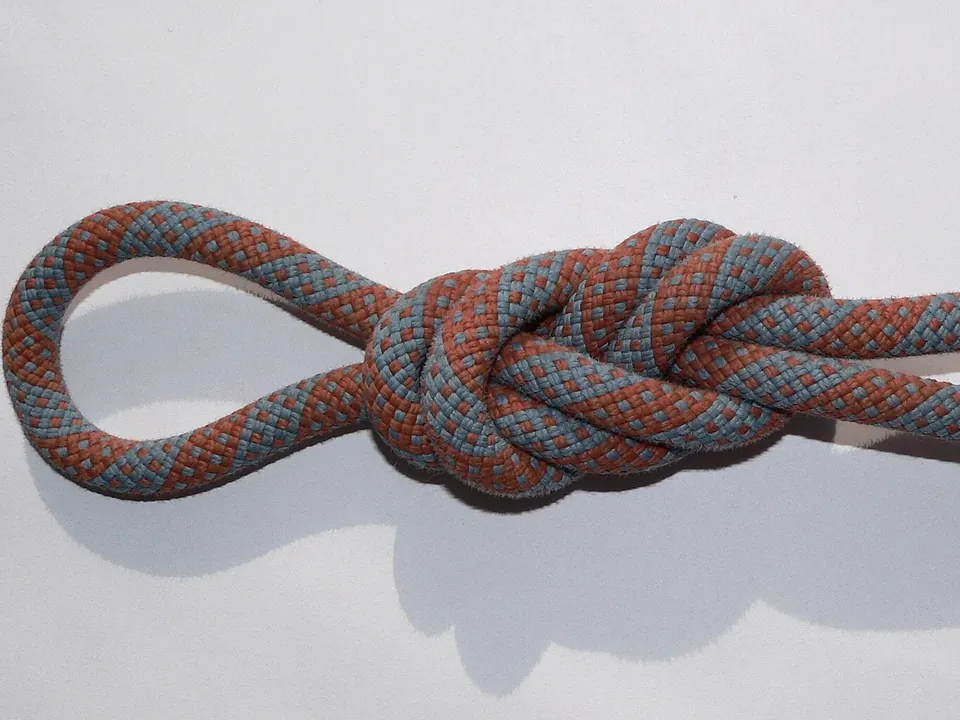
Loop
Figure-eight loop
Turkish: Kapalı sekizli düğümü
The standard climbing tie-in to the harness; makes a strong loop that is easy to inspect.
Life safety: This knot is used in climbing, rescue or tree work. This app does not replace hands-on training; for life-safety work, practise under an instructor.
How to tie it
- Leave a long tail and make a loop: bring the working end OVER the standing part.
- Take the end around BEHIND (under) the standing part.
- Pass the end through the loop: OVER the edge of the loop, UNDER the standing part. This is a loose figure-eight.
- Lead the end up, OVER the bar (harness, ring) and back UNDER it: this is the eye.
- Feed the end back into the figure-eight where it came out and follow the first path in reverse, always alongside it: UNDER the standing part, OVER the edge of the loop, UNDER the standing part.
- Keep following: OVER the standing part, then UNDER both strands.
- Go round the loop and down beside the standing part: OVER two strands, UNDER two, OVER two.
- Pull each of the four strands to dress the knot; the strands must lie side by side, and leave a tail at least a fist long.
The method was checked against: NetKnots: Figure Eight Follow Through, Y. Güngör, Dağcılık, İstanbul Üniversitesi AUZEF ders kitabı, s. 105, AFAD, "İpli Kurtarma Hazırlayıcı Eğitimi" (2025), s. 10.
Turkish names, by who uses them
- Climbers: Kapalı sekizli düğümü, Açık sekizli düğümü, Sekizli düğümü, Sekiz düğümü
- General use: Çiftli sekizli düğümü, Açık sekizli
Other English names: Flemish loop, Flemish eight, figure-eight on a bight, figure-eight follow-through, figure-eight retrace
Main Turkish name from climbers · AUZEF Dağcılık
- Where not to use it
- Where it must come undone easily.
- Weakness
- Jams after heavy loading; leave a tail at least a fist long.
Similar and alternative knots
Sources and verification
- Wikipedia: Figure-eight loop
- Wikidata: Q340952
- The tying steps were played in the rope engine to produce the checking signature; the comparison with two independent sources is in docs/pilot-baglar.md.