Decorative
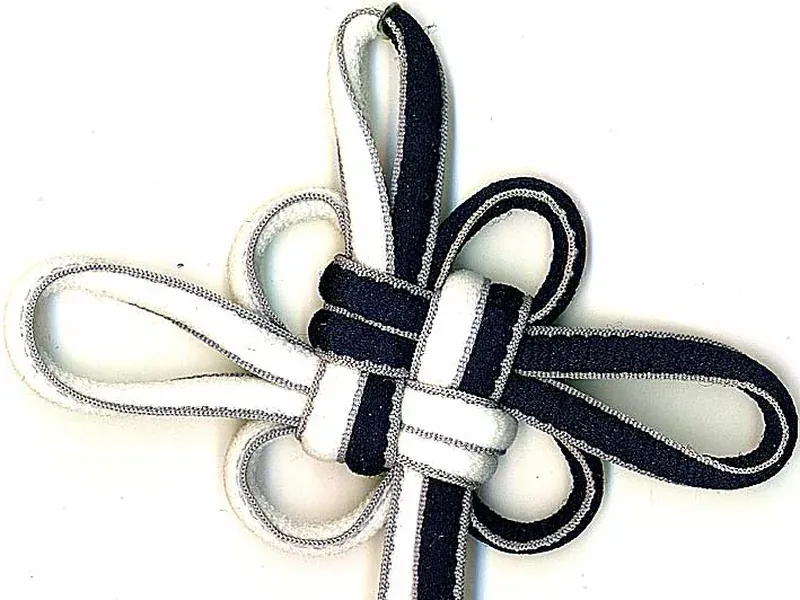
Good luck knot
A traditional decorative knot that looks like a four-leaf flower.
How to tie it
- Fold the cord in the middle: both ends down, one bight each to the right, up and to the left; the four arms meet in the middle (in the holes of a paper template). The animation traces the cord from one end: the right end comes up to the middle. The inner ring is the first crown (anticlockwise), the outer ring the second crown (clockwise).
- Right bight: in the first crown it goes OVER the root of the next arm (the top bight) and UNDER that arm's fold; in the second crown, the other way round, OVER the root of the next arm (the ends) and UNDER its fold, and opens out as a petal.
- Top bight: the same rule. In each crown every arm lies OVER the root of the next, and the next arm's fold lies OVER it; the last arm is tucked UNDER the fold of the first.
- Left bight: in the first crown, as the last arm, it is tucked UNDER the fold of the first arm (the ends); in the second crown it follows the same rule and becomes a petal.
- Left end: it runs through both crowns beside the other end and leaves downwards. The links in the middle (the cord behind the template) become the corner ears when tightened.
- Tear away the paper; pull both crowns evenly so they sit on top of each other. Adjust the corner ears as you like; leave the side petals big enough that the knot does not fall apart.
The method was checked against: ChineseKnotting.org: The Square (4) Good Luck Knot, Art Sprouts: How To Tie A Chinese Good Luck Knot.
Other English names: Shamrock knotAshley, 1993 — p390 — #2436 —, Shamrock knot, knot of seven loops
No sourced Turkish name yet.
- Where not to use it
- In load-bearing work.
- Weakness
- Loses its symmetry if the petals are not pulled evenly.
Similar and alternative knots
Sources and verification
- Wikipedia: Good luck knot
- Wikidata: Q92152071
- The tying steps were played in the rope engine to produce the checking signature; the comparison with two independent sources is in docs/pilot-baglar.md.