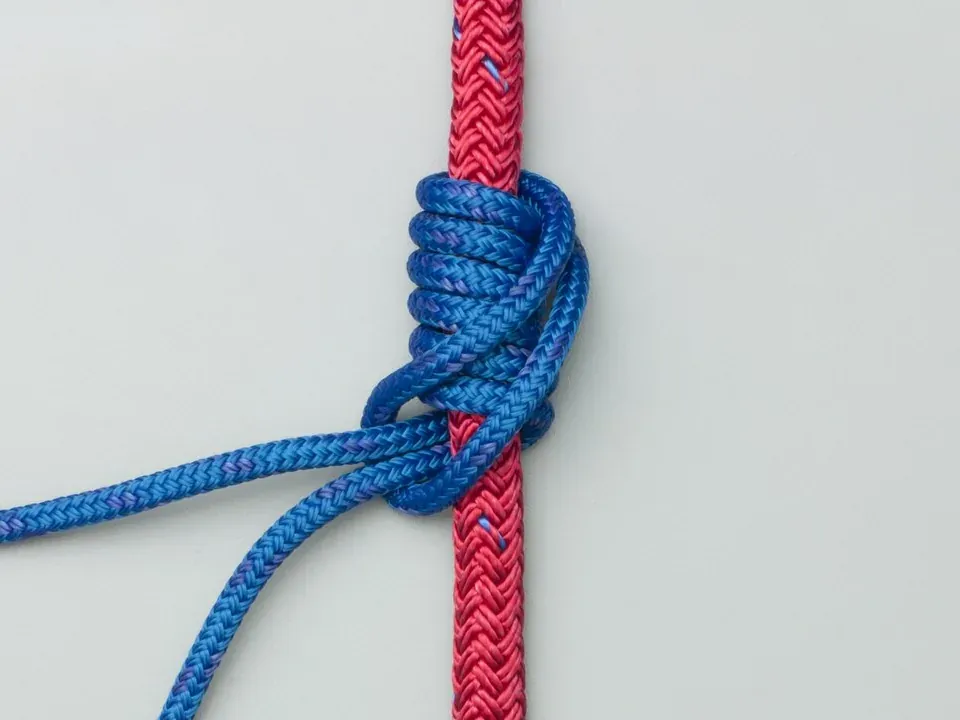
Friction hitch
Klemheist knot
Turkish: Klemheist
Locks like a prusik, can also be tied with tape, and works in one direction.
Life safety: This knot is used in climbing, rescue or tree work. This app does not replace hands-on training; for life-safety work, practise under an instructor.
How to tie it
- The loop is traced as one strand: both legs of the hanging bight (B) go down to the load (the double fisherman's knot is far away). The first leg is laid going up on the left and back down.
- With the first leg wrap the main rope three times from the bottom up: OVER (in front), UNDER (behind)… Leave room between the wraps for the second leg.
- At the top lead the end of the loop (A) out to the left and back: the upper leg of bight A passes OVER the leg of B, the lower leg UNDER it.
- Bring the second leg back down beside the same wraps: UNDER, OVER… The loop is now wrapped double round the main rope.
- Take the lower bight (B) up and through A (OVER its lower leg, UNDER its upper leg), then pull it back to the left and down to the load.
- Dress the wraps and tighten; load only the hanging bight. If it slips, add a wrap.
The method was checked against: Animated Knots: Klemheist Knot, Wikipedia: Klemheist knot.
Turkish names, by who uses them
- General use: Klemheist
Other English names: French Machard knot, Klemheist
Main Turkish name from general use · AFAD Akarsu Kurtarma
Sources for the names
- Where not to use it
- Where it must lock in both directions.
- Weakness
- Holds in one direction only.
Similar and alternative knots
Sources and verification
- Wikipedia: Klemheist knot
- Wikidata: Q1788384
- The tying steps were played in the rope engine to produce the checking signature; the comparison with two independent sources is in docs/pilot-baglar.md.