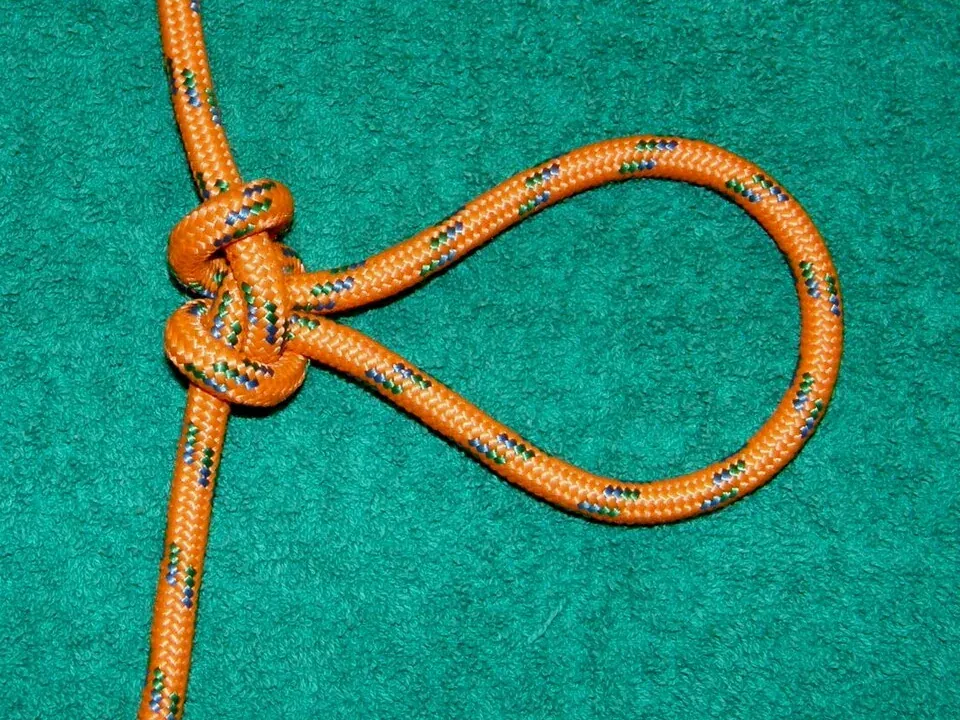
Loop
Alpine butterfly loop
Turkish: Kelebek
Makes a fixed loop in the middle of a rope that takes load in three directions; also isolates a damaged section.
Life safety: This knot is used in climbing, rescue or tree work. This app does not replace hands-on training; for life-safety work, practise under an instructor.
How to tie it
- The butterfly is tied in the bight, mid-rope; here we trace the path the rope takes with the end. The left leg already forms a large loop; bring the leg up OVER its standing part.
- Curl the leg round and tuck it into the loop: in UNDER the standing part, out OVER the bottom of the loop. This is a loose overhand knot.
- Lead the bight down, OVER the bar (carabiner) and back UNDER it: this is the eye.
- Bring the other leg of the bight up through the left loop: OVER its upright side, then UNDER it, and turn to the right.
- With this leg draw a second loop round the first knot: UNDER its own leg, OVER the bottom of the left loop, UNDER the left leg, then OVER it, UNDER the top of the left loop, OVER its own leg.
- Take the right leg UNDER its own tail and out to the right: the other side of the line.
- Pull the eye and both legs together to tighten; a correct butterfly looks symmetric from both sides.
The method was checked against: Animated Knots: Alpine Butterfly Loop, Y. Güngör, Dağcılık, İstanbul Üniversitesi AUZEF ders kitabı, s. 109.
Turkish names, by who uses them
- Sailors: Kelebek
- Climbers: Kelebek düğümü, Alpin kelebek düğümü
- General use: Alp kelebeği
Other English names: alpine butterfly knot, butterfly knot, lineman's loop, lineman's rider
Main Turkish name from sailors · Boğaziçi Yelken
Sources for the names
- Y. Güngör, Dağcılık, İstanbul Üniversitesi AUZEF ders kitabı
- Boğaziçi Üniversitesi Yelken, "Düğüm-1" ve "Düğüm-2" ders notları (2024)
- TÜBİTAK Bilim Çocuk, Temmuz 2019 eki "Düğümler"
- AFAD, "İpli Kurtarma Hazırlayıcı Eğitimi" (2025)
- AFAD, "Akarsuda Arama ve Kurtarma Temel Eğitimi" (2025)
- Boğaziçi Üniversitesi Yelken Takımı, "Temel Yelkencilik Eğitim Kitabı"
- Where not to use it
- When you need a loop in the end of the rope (a figure-eight loop or bowline is better).
- Weakness
- A wrong tie is not obvious; learn to recognise the correct shape.
Similar and alternative knots
Sources and verification
- Wikipedia: Butterfly loop
- Wikidata: Q1503006
- The tying steps were played in the rope engine to produce the checking signature; the comparison with two independent sources is in docs/pilot-baglar.md.