Bend
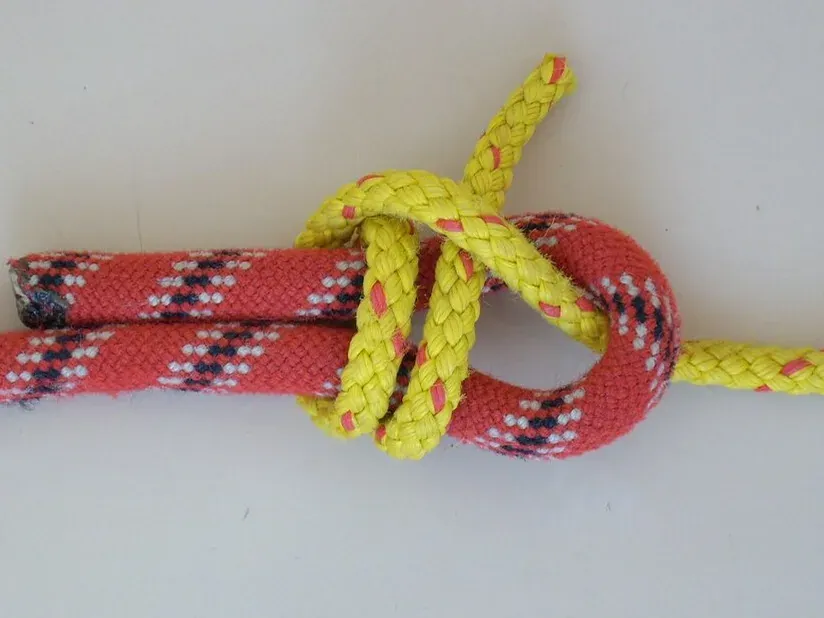
Double sheet bend
Turkish: Çifte sancak bağı
Adds a second turn to the sheet bend for a safer join in slippery ropes or ropes of very different thickness.
How to tie it
- The other rope lies as a bight: its standing part on the left, its short end on the right. Pass the working end UNDER the bottom of the bight and up through it.
- Bring the working end out OVER the right leg and round BEHIND (under) both legs of the bight.
- Bring the end OVER the left leg, UNDER its own standing part and out OVER the right leg: a sheet bend.
- Take the end round a second time, outside the first turn, BEHIND (under) both legs of the bight.
- Again bring the end OVER the left leg, UNDER its own standing part beside the first tuck, and out OVER the right leg.
- Pull the end and the standing parts together to tighten. Both short ends finish on the same side.
The method was checked against: MEB MEGEP, Gemici Bağları modülü (2014), s. 6, NetKnots: Sheet Bend.
Turkish names, by who uses them
- Seafarers: Çifte sancak bağı, İskota bağı
- Fishers: Çift sancak düğümü
- Scouts: Çifte sancak bağı
Main Turkish name from seafarers · Sahil Güvenlik, KÜRE (Deniz Harp Okulu), MEB
Sources for the names
- Sahil Güvenlik Komutanlığı, "Gemici Bağları"
- KÜRE Ansiklopedisi, "Gemici Bağları" (MSÜ Deniz Harp Okulu "Denizcilik Köşesi", Sahil Güvenlik ve MEB'e dayanır)
- MEB MEGEP, Denizcilik: Gemici Bağları modülü (2014)
- MEB MEGEP, Denizcilik: Ağ Bakımı ve Onarımı modülü (2016)
- Sakarya İzcileri, "İzci düğümleri: Gemici bağları"
- Where not to use it
- Where it must be released quickly (a slipped sheet bend suits better).
- Weakness
- Loses security if the turns get crossed.
Similar and alternative knots
Sources and verification
- Wikipedia: Sheet bend
- The tying steps were played in the rope engine to produce the checking signature; the comparison with two independent sources is in docs/pilot-baglar.md.