Bend
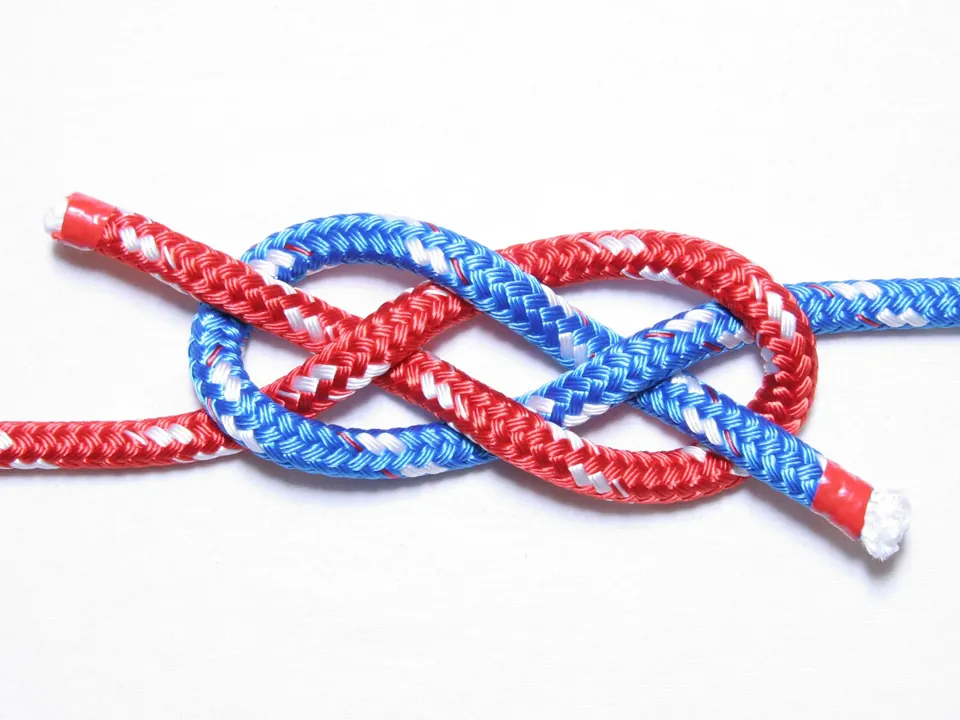
Carrick bend
Turkish: Yoma bağı
Joins heavy ropes and hawsers; it does not jam under load and unties easily afterwards.
How to tie it
- A loop is laid in the first rope. Pass the end of the second rope UNDER this loop: in under one side and out under the other.
- Take the end OVER the standing part of the first rope.
- Take the end UNDER the end of the first rope.
- Bring the end OVER the loop into it.
- Take the end UNDER its own part, then out OVER the loop; the two ends finish at diagonally opposite corners.
- Pull both standing parts gently to tighten; the knot capsizes into its compact form.
The method was checked against: NetKnots: Carrick Bend, TÜBİTAK Bilim Çocuk, Temmuz 2019 eki "Düğümler", s. 3.
Turkish names, by who uses them
- Seafarers: Yoma bağı, Çifte yoma bağı
- General use: Yoma bağı
Other English names: Josephine knot, Double coin knot
Main Turkish name from seafarers · MEB, KÜRE (Deniz Harp Okulu)
- Where not to use it
- In thin, slippery rope unless the ends are seized.
- Weakness
- Changes shape under load; the ends can slip unless they are seized to the standing parts.
Similar and alternative knots
Sources and verification
- Wikipedia: Carrick bend
- Wikidata: Q2142794
- The tying steps were played in the rope engine to produce the checking signature; the comparison with two independent sources is in docs/pilot-baglar.md.