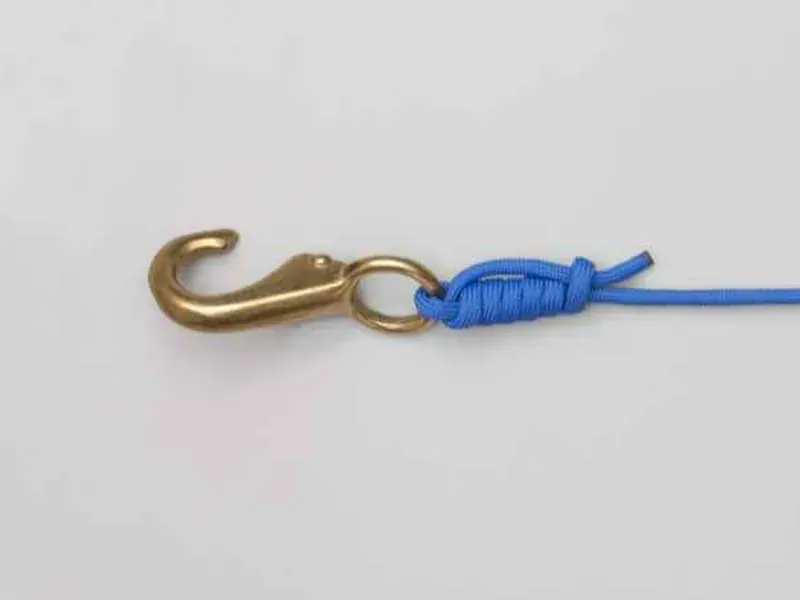
Pass the end of the line through the eye of the hook or lure and fold the working end back alongside the standing part.
Keeping a loop over your finger where the working end turns back, wrap the working end toward the eye around both lines lying side by side; use more wraps on light line and fewer on heavy line (the sources give 3 to 8).
Pass the working end between the two lines, between the last wrap and the eye.
Bring the working end back and pass it through the large loop held by your finger, parallel to the standing part.
Wet the knot, tighten it slowly so the wraps form a neat spiral without overlapping, and trim the excess end.
To tie heavy metal jigs (iron jigs) to the line quickly and reliably on board.
When
Unknown; no date appears in the sources.
Who devised it
Unknown; it is thought to have come from tuna anglers fishing out of San Diego on long-range boats.
Where the name comes from
San Diego, in the name, is the sport-fishing hub where the knot became popular (Animated Knots, NetKnots); the sources do not explain the names reverse clinch and Heiliger.
Its story
The San Diego jam knot attaches fishing line to a hook, a swivel, a clip or an artificial fly; other names for it are the reverse clinch knot and the Heiliger knot. According to the sources it grew out of the need of tuna anglers on long-range boats heading into Mexican waters to tie on heavy metal jigs quickly and reliably, and for a long time it was little known outside the sport-fishing hub of San Diego. It works with monofilament, fluorocarbon and braided line; Animated Knots writes that comparison tests suggest it keeps more of the line's strength than most fishing knots. Knots 3D treats it as a near twin of the Pitzen knot: the two differ only in that the San Diego jam also takes the working end through the lower loop next to the eye.
On hooks without an eye; the knot has to be tied through an eye or ring.
Weakness
If it is tightened dry, friction heat can weaken the line; the wraps must lie in a tidy spiral without overlapping, and their number has to suit the thickness of the line.