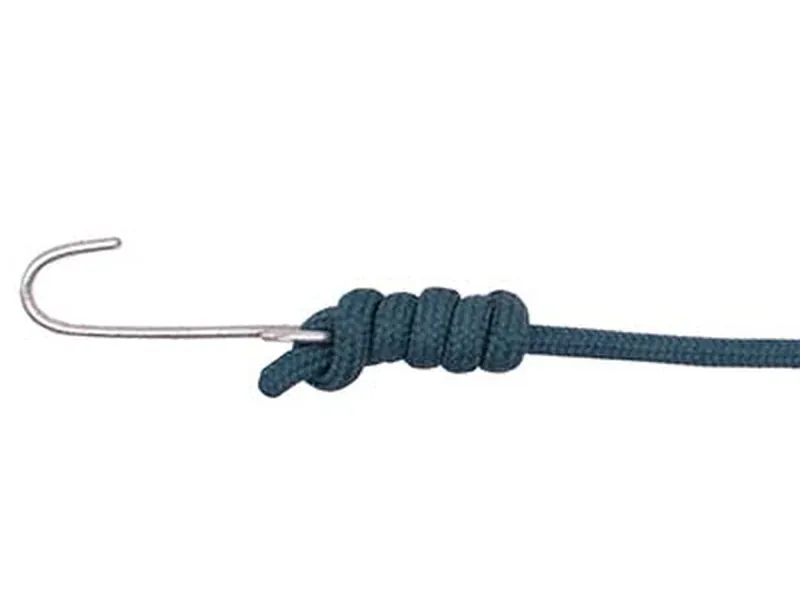
Fastening line to the eye of a hook, swivel or lure with a small knot that is quick to tie.
When
Unknown; no date appears in the sources.
Who devised it
Unknown.
Where the name comes from
Wikipedia also calls it the half blood knot: two of them tied facing each other make the blood knot that joins two lines. Wired2Fish also gives the name cinch knot.
Its story
The clinch knot is a plain way to tie line to the eye of a hook or swivel; Wired2Fish calls it the first knot many anglers learn and notes that it is also known as the cinch knot. Wikipedia's blood knot article also calls it the half blood knot: two of them tied facing each other to join two lines count together as a blood knot. It adds that, for a medium hook on medium line, few knots are stronger, and that surgeons have used it to secure slippery monofilament sutures. According to NetKnots it has largely given way in recent years to the improved clinch, which adds one more tuck, yet many fly fishing guides still rely on it all day, because they trust it and, twisting the line with a finger, can tie it very quickly.
On slick line such as braid, or very fine fluorocarbon on a large hook, where it can slip; when the fly should swing freely in the eye, a loop knot is preferred.
Weakness
Without the final tuck it slips more readily than the improved clinch, and too few wraps or tightening it dry cut its grip and strength.