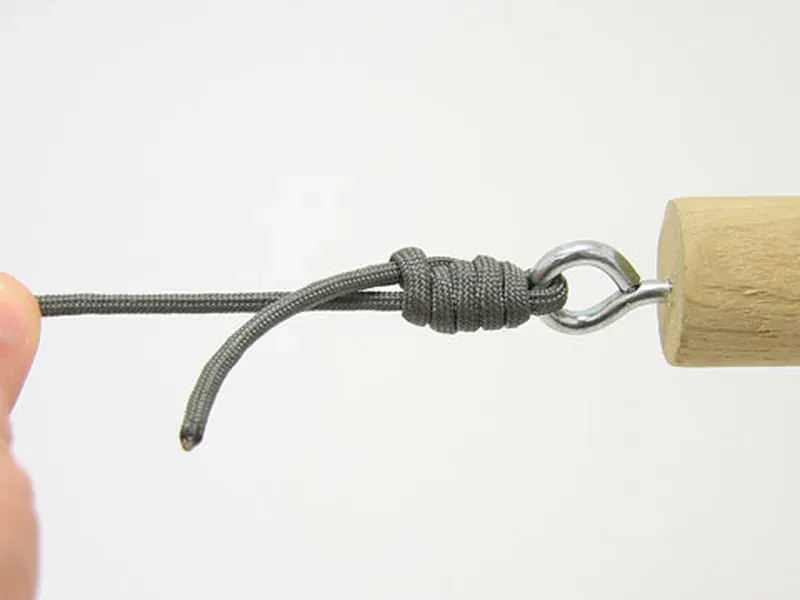
Thread the hook eye with the line, bring the working end back beside the standing part and take it round UNDER the standing part to make a small loop.
Holding the loop on your fingertip, wrap the working end round the two parallel legs (the standing part and the returning end), working towards the hook eye; NetKnots gives four wraps, the Knots 3D animation shows five.
Bring the working end back along the outside of the wraps and pass it through the small loop held on your finger.
Draw the knot up on the standing part, wet it and push it down to the eye with your fingertips rather than by hauling on the standing part; give the final hard pull only once it sits at the eye.
Tying a hook, lure or fly to fine line while keeping as much of the line's strength as possible.
When
Unknown; no date appears in the sources for Pitzenbauer. E. Richard Nightingale wrote about it as the '16-20 knot' in American Angler in 2002.
Who devised it
According to the sources, the German fly fisherman Edgar Pitzenbauer; Knots 3D writes that other anglers also found the same knot independently.
Where the name comes from
The name Pitzen comes from Edgar Pitzenbauer, Eugene bend from Ken Eugene, and 16-20 knot from the 16-20 club.
Its story
The Pitzen knot takes its name from the German fly fisherman Edgar Pitzenbauer; Knots 3D writes that several anglers came upon the knot separately and that Pitzenbauer was the first. The name 'Eugene bend' refers to Ken Eugene, whom both sources link to the San Jose Fly Casters Club, and the well-known fly fisherman Lefty Kreh at one point referred to it just as the 'Fisherman's Knot'. E. Richard Nightingale introduced it in the March–April 2002 issue of American Angler as the '16-20 knot', a name taken from the '16-20 club', whose members are fly anglers who have landed a salmon of 16 lb on a size 20 fly.
Heavy line, where it is harder to tie (NetKnots notes that light line and tippets are easier); for slippery braid NetKnots describes the San Diego jam knot, which adds a pass through the lower opening.
Weakness
If it is not wetted while tightening, friction heat can weaken the line; it should be slid down to the eye with the fingertips rather than by pulling the standing part.