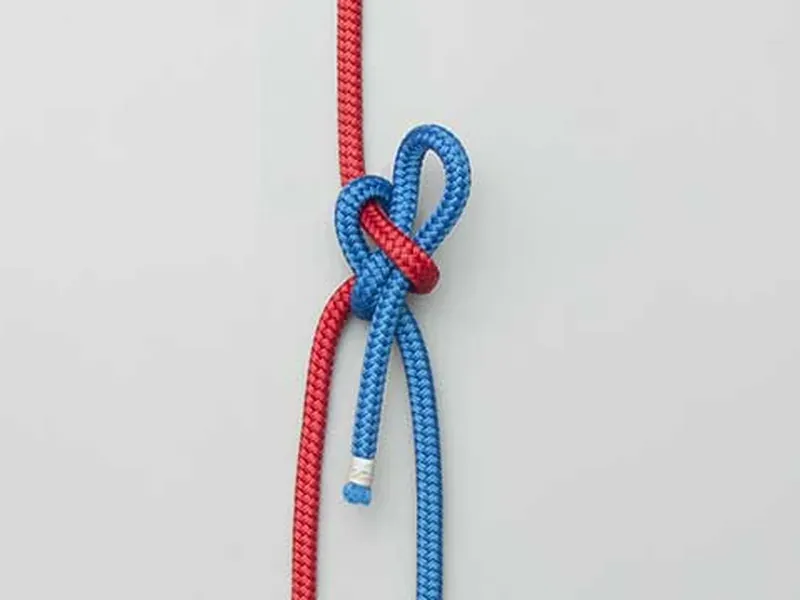
Lets an arborist tie a second rope to a bight taken in the middle of the climbing line, haul it up, and then free it at once by pulling the short end.
MediumNo ABoK numberTree work
Life safety: This knot is used in climbing, rescue or tree work. This app does not replace hands-on training; for life-safety work, practise under an instructor.
Letting a climber in a tree haul a second rope up quickly and release it from the main line with one pull.
When
Unknown; the earliest known written record in tree work is from September 1996 (Treeworker, National Arborist Association).
Who devised it
Unknown; Jepson notes that the first published description did not reliably trace where it came from.
Where the name comes from
Animated Knots ties the name to how fast it is both to tie and to undo.
Its story
Arborists use the quick hitch to haul a second rope up a tree with the climbing line. Animated Knots, drawing on Jeff Jepson's The Tree Climber's Companion (2000), says the knot's earliest description appeared in the National Arborist Association's Treeworker magazine in September 1996, though that article gave no trustworthy account of where the knot came from. Knots 3D and Wikipedia note that its structure is the same as the slipped Lapp knot; Wikipedia writes that arborists call the slipped Lapp bend the 'quick hitch' and that pulling its end makes it fall completely apart without tangling.
In any connection that holds a person or a suspended load; the sources describe it only for hauling a second rope aloft.
Weakness
It is a slipped knot: if the short end snags and is pulled, the whole knot falls apart at once; Wikipedia adds that if it is not drawn up properly before loading it can capsize into a mooring hitch.