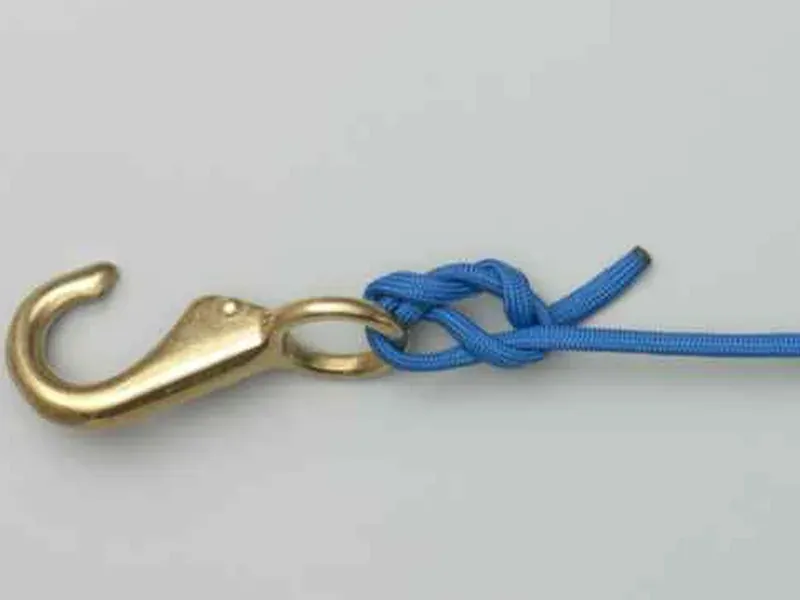
Thread the end of the line upward through the hook (or fly) eye, entering from below, and pull through plenty of working end.
Take the working end round behind the standing part and cross it OVER the standing part to make a first loop near the eye.
Pass the working end through this first loop from the back; the line now forms a figure eight, with a second loop further from the eye.
Fold the working end back and pass it through the second loop twice, starting from the back, so that it makes two turns around that loop.
Wet the knot; pull the hook and the working end to close the second loop onto the standing part, then let go of the end and pull the hook and standing part to seat the knot on the eye.
A contest Orvis held to find the best way to tie line to a hook; a small, strong hook knot that is easy to tie.
When
The 1990s (Knots 3D).
Who devised it
Larry Becker, from Rockford, Illinois, who entered it in the Orvis contest (Knots 3D, Animated Knots).
Where the name comes from
It carries the name of Orvis, the fly fishing company that ran the contest (NetKnots); Knots 3D also calls it the Becker knot.
Its story
The Orvis knot came out of a contest: according to Knots 3D, in the 1990s the fly fishing retailer Orvis held a competition to find the best way to tie line to a hook, and the winner was a variation of the figure-eight knot sent in by Larry Becker of Rockford, Illinois. NetKnots counts it among the 'contest knots', alongside the World's Fair and Fish N Fool knots, and the winning knot was given the name of the company that ran the contest. Knots 3D also calls it the Becker knot and says it keeps nearly all of the line's strength, while Orvis says it works well in lines up to 30 lb.
On line above the 30 lb limit up to which Orvis and Knots 3D say it works well (Animated Knots says it also does well in heavy line; no test figures are given for the limit).
Weakness
It tends to set at an angle on the eye as it is tightened, and pulling it up dry can heat and weaken the line.