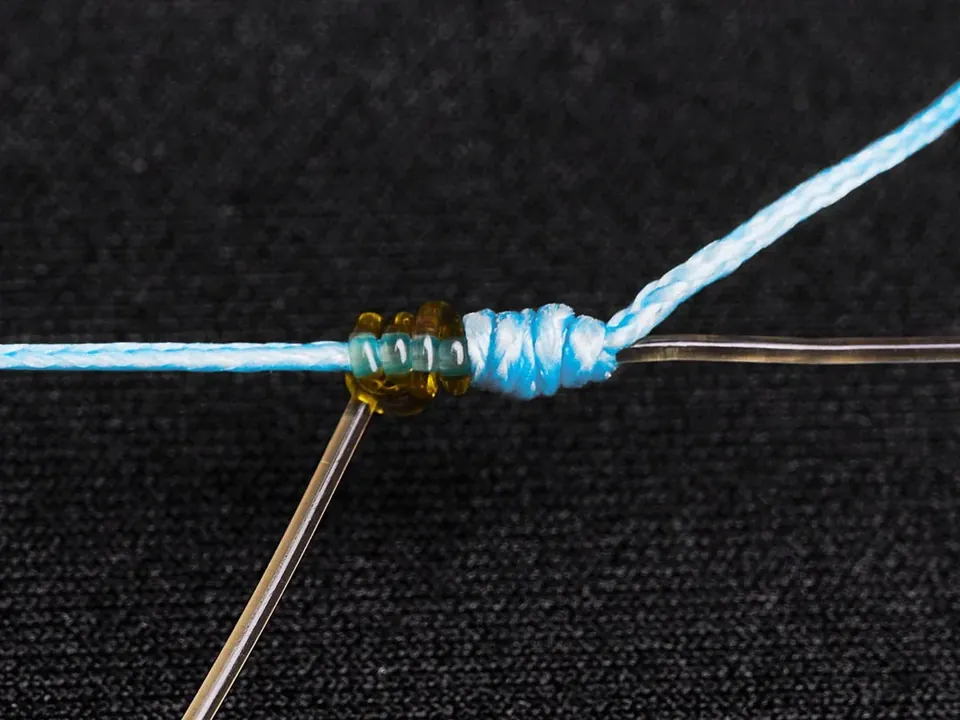
Joins two fishing lines with a uni knot tied by each line around the other; used for lines of the same or different diameter and for tying braid to a leader.
Lay the ends of the two lines alongside each other for some distance, coming from opposite directions.
Double back the working end of one line to form a loop beside both lines.
Pass the working end through the loop and wrap it 3–5 times around both lines (use more wraps, 6–8, on slick braid), then pull the working end to tighten this first uni knot.
Do the same with the other line's working end in the opposite direction: double it back into a loop, wrap around both lines through the loop, and tighten.
Wet the knots and pull the two standing parts in opposite directions so that the two uni knots slide together and seat.
To join two fishing lines of the same or different diameter with an easy knot, especially slick braid to a monofilament or fluorocarbon leader.
When
Unknown; the sources do not say when the join was first used. The knot it is built from was published by Ashley in 1944 as the gallows knot, worked out again for fishing in the early 1960s and spread under the uni knot name in 1970.
Who devised it
Unknown; Norman Duncan developed the underlying uni knot as a fishing knot (independently of Ashley, according to Wikipedia), Vic Dunaway spread it in his Uni Knot System, and Animated Knots describes joining two lines with uni knots as part of that system.
Where the name comes from
It is made of two uni knots, hence double uni or uni-to-uni; because the uni knot is called the grinner in British English, it is also known as the double grinner.
Its story
The double uni is a join made of two uni knots, each line tying one around the other. The underlying knot appears in Ashley's 1944 book as the gallows knot; according to Wikipedia, in the early 1960s Norman Duncan worked it out on his own for fishing, and Vic Dunaway, who edited at the Miami Herald, spread the uni knot name through a 1970 fishing book. According to Animated Knots, Dunaway's Uni Knot System, meant to cover every fishing job with a single knot, joins two lines in just this way, with a uni tied by each line around the other. NetKnots reports that the well-known bass angler Roland Martin considers it the best way to join braid to a leader of fluorocarbon or monofilament.