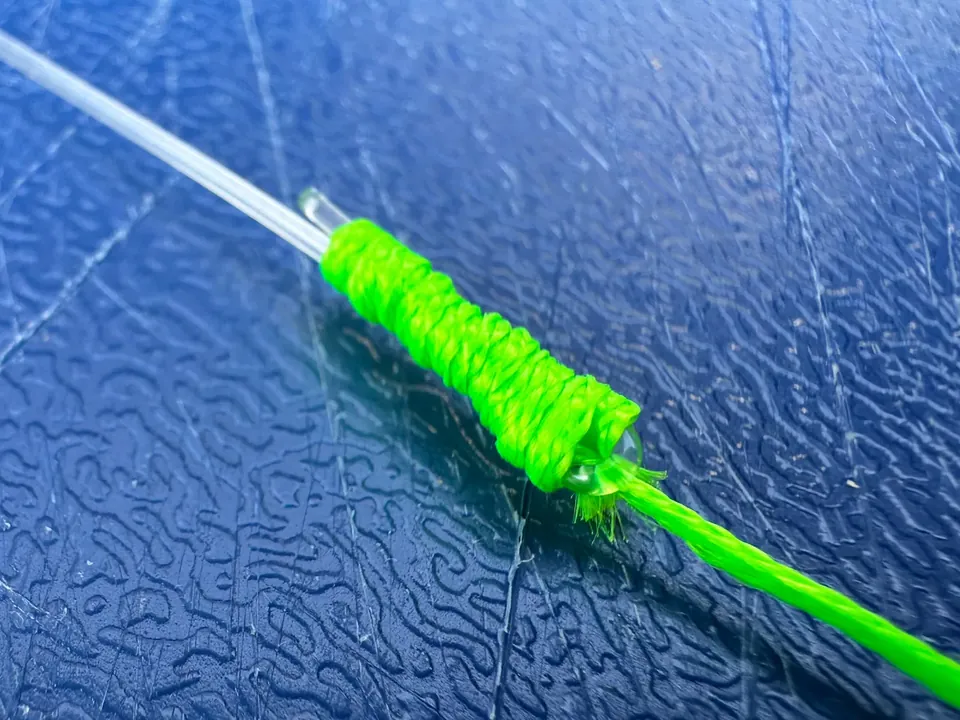
Fold the end of the leader back 15–20 cm to form a bight.
Pass 15–25 cm of the braid's end through this bight.
Wrap the braid 7 times around the doubled leader, working down it away from the tip of the bight.
Then wrap 7 more times back toward the bight, laying these turns OVER the first ones.
Pass the braid's working end back through the bight so that it leaves on the same side it entered.
Holding the braid and its tail together, pull slowly so the wraps gather at the end of the bight, then pull the braid and the leader hard in opposite directions.
To join thin, slippery braid to a thicker mono or fluorocarbon leader so that the connection does not slip.
When
1990s (Outdoor Life); Knots 3D gives 1993.
Who devised it
'Crazy' Alberto Knie, a surf caster (Outdoor Life, Netknots, Knots 3D).
Where the name comes from
Named after its inventor; also called the Crazy Alberto or modified Albright (Knots 3D).
Its story
According to Outdoor Life, when braided line spread in the 1990s, 'Crazy' Alberto Knie, a well-known surf caster from the Northeast, found that the thin, slick braid tended to slip out of knots tying it to a heavier leader when a big striped bass pulled, and he modified the Albright to make this knot. Knots 3D gives 1993 as the year. Netknots and Knots 3D quote Knie saying he made the knot for himself and that friends, including world record holders, took it up.
For joining lines of similar thickness; Outdoor Life says the leader should be clearly thicker than the braid.
Weakness
If cinched in a hurry, the wraps bunch up short of the leader's folded tip; it also depends on details such as the tail leaving the loop on the side it went in.