Slim beauty knot TR
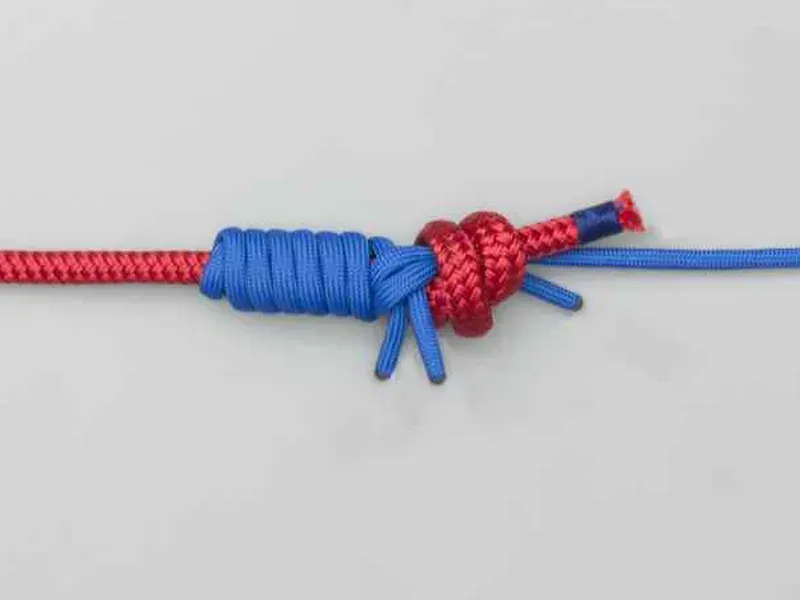
Slim beauty knot, tied and tightened

Bend

Slim beauty knot

Joins two lines that differ in thickness or material, such as a thin main line or braid to a heavy leader, with a slim, straight connection; tarpon anglers use it in place of a Bimini twist.

Medium No ABoK number Fishing

The animation and practice area for this knot are not ready yet. Available now: Overhand knot, Figure-eight knot, Double overhand knot, Stevedore knot, Ashley's stopper knot, Heaving line knot, Monkey's fist, Slip knot, Sheet bend, Double sheet bend, Carrick bend, Fisherman's knot, Double fisherman's knot, Water knot, Flemish bend (figure-eight bend), Offset overhand bend, Zeppelin bend, Hunter's bend, Butterfly bend, Blood knot (barrel knot), Albright special, Nail knot, Harness bend, Heaving line bend, Racking bend, Reever knot, Simple Simon over, Beer knot, Adjustable bend, Bowline, Double bowline, Water bowline, Bowline on a bight, Spanish bowline, Yosemite bowline, Cowboy bowline, Running bowline, Eskimo bowline, Figure-eight loop, Directional figure eight, Double figure-eight loop, Figure-of-nine loop, Alpine butterfly loop, Overhand loop, Angler's loop (perfection loop), Dropper loop, Farmer's loop, Artillery loop (manharness knot), Fireman's chair knot, Honda knot, Zeppelin loop, Bimini twist, Clove hitch, Slipped clove hitch, Cow hitch (lark's head), Half hitch, Two half-hitches, Round turn and two half-hitches, Anchor bend (fisherman's bend), Timber hitch, Killick hitch, Rolling hitch, Magnus hitch, Taut-line hitch, Buntline hitch, Cleat hitch, Highwayman's hitch, Tumble hitch, Mooring hitch, Halter hitch, Pile hitch, Constrictor knot, Strangle knot, Trucker's hitch, Siberian hitch, Marlinespike hitch, Pipe hitch, Tensionless hitch, Munter hitch, Cat's paw, Ground-line hitch, Becket hitch, Halyard bend, Lobster buoy hitch, Barrel hitch, Bale sling hitch, Swing hitch, Prusik knot, Klemheist knot, Bachmann knot, Autoblock (French prusik), Blake's hitch, Distel hitch, Adjustable grip hitch, Reef knot (square knot), Granny knot, Thief knot, Miller's knot, Packer's knot, Boa knot, Transom knot, Sheepshank, Chain sinnet, Square lashing, Diagonal lashing, Shear lashing, Common whipping, Sailmaker's whipping, Improved clinch knot, Palomar knot, Uni knot, Trilene knot, Arbor knot, Turle knot, Turk's head knot, Carrick mat, Wall and crown knot, Matthew Walker knot, Diamond knot, Chinese button knot, Celtic button knot, Pan Chang knot, Good luck knot, True lover's knot, Friendship knot.

How to tie it

  1. Put a double overhand knot near the tip of the heavier line (the leader) and snug it only partly, so that it opens into a figure eight with two loops.
  2. Double the end of the thin main line into a bight and pass the bight through both loops of the double overhand knot.
  3. Wrap the doubled line four times round the leader, working away from the knot.
  4. Then wrap back towards the knot over the first wraps (Animated Knots shows four turns, NetKnots three).
  5. Pass the end of the bight through the first gap in the wraps on the knot side, under the doubled line itself.
  6. Wet the knot; first draw up the double overhand in the leader, then haul the leader and both strands of the main line (leave the bight alone) apart with a quick, steady pull to seat the wraps.
  7. Trim the bight and the ends short.

The method was checked against: Animated Knots (Grog): Slim Beauty Knot, NetKnots (John E. Sherry): Slim Beauty Knot.

Origin and story

Why it was needed
Joining a thin line to a heavier one in a tarpon leader with a strong, less visible connection that is quicker to tie than a Bimini twist.
When
Its roots go back to Tom Pierce's experiments in Key West in the 1970s; Simon Becker writes that he began tying it in 1993, while MidCurrent's editor's note and Animated Knots place the present form in the early 1990s and NetKnots in the 1990s.
Who devised it
Simon Becker (a tarpon guide in the Florida Keys), building on Tom Pierce's methods.
Where the name comes from
According to Becker, from the nickname 'Slim Beauty' that a waitress at a Cuban restaurant in Key West gave his friend.

Its story

The slim beauty joins a thin line to a heavier one with a slim, straight connection; it took its present form in tarpon leaders in the Florida Keys. MidCurrent's editor's note traces it to Captain Tom Pierce, who guided light-tackle anglers out of Key West in the 1970s and looked for a better way to join Dacron to mono: his first answer was a clinch knot seated against a figure-eight knot, and he later swapped the clinch for a run of wraps locked at the end; according to the same note, Becker developed this further in the early 1990s into today's knot. Simon Becker, a fly fishing guide in the Florida Keys, writes that he took up the knot in 1993 because tying hundreds of Bimini twists over a tarpon season had left his fingers sore. As Becker tells it, the name comes from a waitress at a Cuban restaurant in Key West who one evening nicknamed him 'Slim Slick' and his friend 'Slim Beauty'.

Source: MidCurrent: History of the 'Slim Beauty' Knot (Simon Becker; editör notuyla), Animated Knots (Grog): Slim Beauty Knot, NetKnots: Slim Beauty Knot.

No sourced Turkish name yet.

Where not to use it
For tying line to a hook, lure or swivel; this knot joins one line to another.
Weakness
The number of wraps varies between sources and it must be pulled very hard to seat; Animated Knots points out that claims of near full line strength are measured against the line's rated strength, not against tests of the line under the same conditions.
Similar and alternative knots

Sources and verification

  • The card was written in our own words from Wikipedia and Wikidata data; the tying method has not yet been checked against two sources.