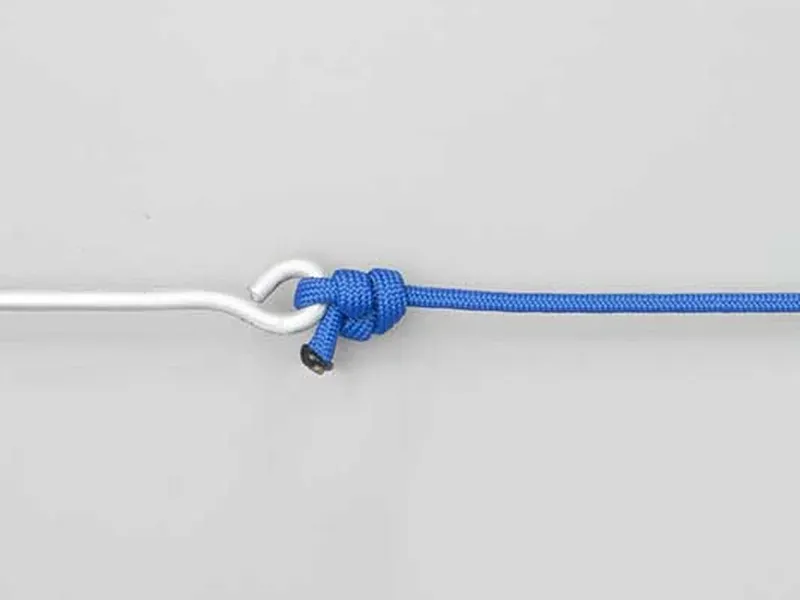
Thread the tippet through the hook's eye and leave about 7–10 cm of working end.
Take the working end around the standing part and back out through the loop that runs through the eye, making a loose half hitch.
Keep going around with the working end and pass it through the same loop a second time, between the half hitch and the hook eye; up to here this is the single Davy knot.
Take the working end around once more and pass it through the same loop a third time.
Pull first on the working end, then on the standing part, to tighten the knot; the tag should end up tucked under the knot, right at the eye.
A hook knot as quick and small as the Davy knot but more secure, especially on heavy-wire hooks and larger flies.
When
Unknown; the sources give no separate date for the Double Davy. The Davy knot it comes from is dated to the 1950s (Knots 3D).
Who devised it
Knots 3D credits both the Davy and the Double Davy to Welsh fly fisherman Davy Wotton; Animated Knots describes the Double Davy as derived from Wotton's Davy knot.
Where the name comes from
It takes its name from the Davy knot credited to Davy Wotton; the Double Davy differs from it only by one more pass of the tag end through the loop.
Its story
The Double Davy is a version of the Davy knot, which is credited to the Welsh fly fisherman Davy Wotton; in it the tag makes one extra pass through the loop. Animated Knots writes that the aim was a knot that keeps the Davy's speed and small size but holds better in certain conditions, and it quotes Wotton on a blog describing two ways he ties it. NetKnots recommends switching to it from the Davy for flies from about size 16 upward, as tippets get heavier and hook eyes larger; Animated Knots likewise says the Davy tends to slip on thicker eye wire, where the Double Davy is the better choice.