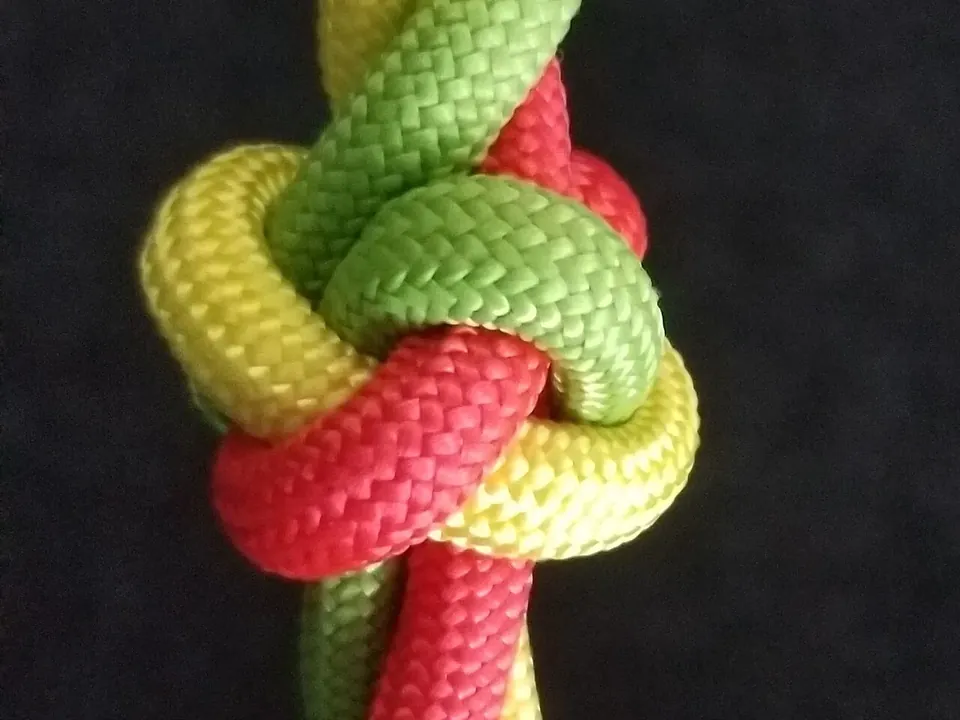
Unlay the strands of the rope a good way, up to where the knot is to go; try to keep each strand's own twist.
Bend each strand down along the standing part to make three bights, and hold the strand ends together with the standing part in one hand.
Lead the first strand's end OVER its neighbour, the second strand, then push it upward through the third strand's bight.
Lead strand two OVER strand three, then push it upward through the first strand's bight.
Lead strand three OVER strand one, then push it upward through the second strand's bight.
Draw the strands up a little at a time, starting where they leave the knot; then lay the strands up again to restore the rope, or seize their ends together.
Making a large knot with a rope's own strands in the middle of the rope, as a handhold or stopper (side ropes, bell ropes, yard band strops).
When
Unknown; it is described in Darcy Lever's (1760?–1837) book and by Dana in 1841.
Who devised it
Unknown.
Where the name comes from
The sources do not explain the name; the same name is also used for the two-ended knife lanyard knot (Wikipedia).
Its story
This diamond knot is worked with the strands of a three-strand rope some way from the end (once it is finished the strands are laid up again and the rope carries on); Darcy Lever's (1760?–1837) The Young Sea Officer's Sheet Anchor describes it for places such as a ship's side ropes and bell ropes; R. H. Dana gives the same method in The Seaman's Friend in 1841, and William Brady's The Kedge-Anchor notes its use on foot-ropes and man-ropes. In 1916 Hjalmar Öhrvall, writing in Swedish in Om knutar, pointed out that the strands are braided around one another before they leave the knot, which he thought should make it firmer, and mentioned it as a stopper on yard band strops and gangway ropes. The same name is also used for the knife lanyard knot, tied with both ends of a cord; Wikipedia mentions a suggestion to keep the two apart by giving the cord knot only the name knife lanyard knot.
On braided or sheathed rope, where the strands cannot be separated, and where the rope must pass through a block or a narrow hole.
Weakness
The strands must be unlaid a long way and laid up again afterwards; unless they are drawn up in turn starting from where they leave the knot, it does not sit neatly.