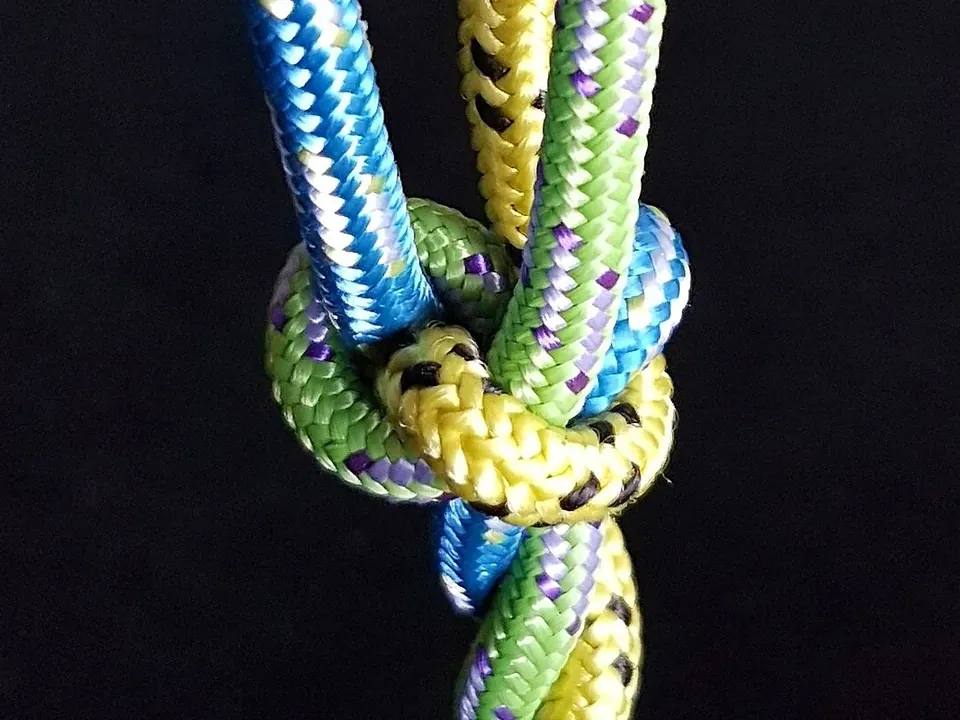
Open the three strands of the rope's end for a few turns and tape their tips; hold the rope with the strands pointing up.
Bend the first strand down so it leaves a bight, and lead it UNDER its neighbour, the second strand.
Lead the second strand UNDER the tail of the first strand, then UNDER the third, again leaving a bight.
Lead the third strand UNDER the tail of the second, then bring it upward through the bight left by the first strand.
Draw the strands up a little at a time, in turn, until the three bights sit evenly; the tails stick out of the knot's crown and can be cut short or tucked back into the rope.
Keeping the end of a laid rope from unravelling and making it too thick to slip through a hole; a base for decorative knots.
When
Since at least the 17th century; the name 'wall knot' is found in John Smith's work of 1627.
Who devised it
Unknown.
Where the name comes from
Its spelling changed over the centuries: 'wale knot' (1644), 'whale knott' (1750), 'walnut' (1769).
Its story
The wall knot is worked with the three strands of a laid rope where they have been opened at its end, and written records of it go back to the 17th century. Ashley lists early spellings of the name: 'wall knot' (John Smith, 1627), 'wale knot' (Manwayring, 1644), 'whale knott' (Blanckley, 1750) and 'walnut' (Falconer, 1769). It stops the rope end from fraying and thickens it so that it will not pull through a hole, though its main role is as the foundation of ornamental knots like the wall and crown and the double Matthew Walker. Öhrvall wrote in 1916 that it can be tied either with or against the twist of the rope, and that the strands are bent less sharply when it follows the twist.
Other English names: Doubled wall and crown, Wall and crown knot
No sourced Turkish name yet.
Where not to use it
On braided or sheathed rope, where the strands cannot be separated, and where the end must pass through a hole or block only slightly larger than the rope.
Weakness
The strands only sit neatly if they are drawn up in turn with care; unless the ends are tucked back into the rope it is just a small stopper.