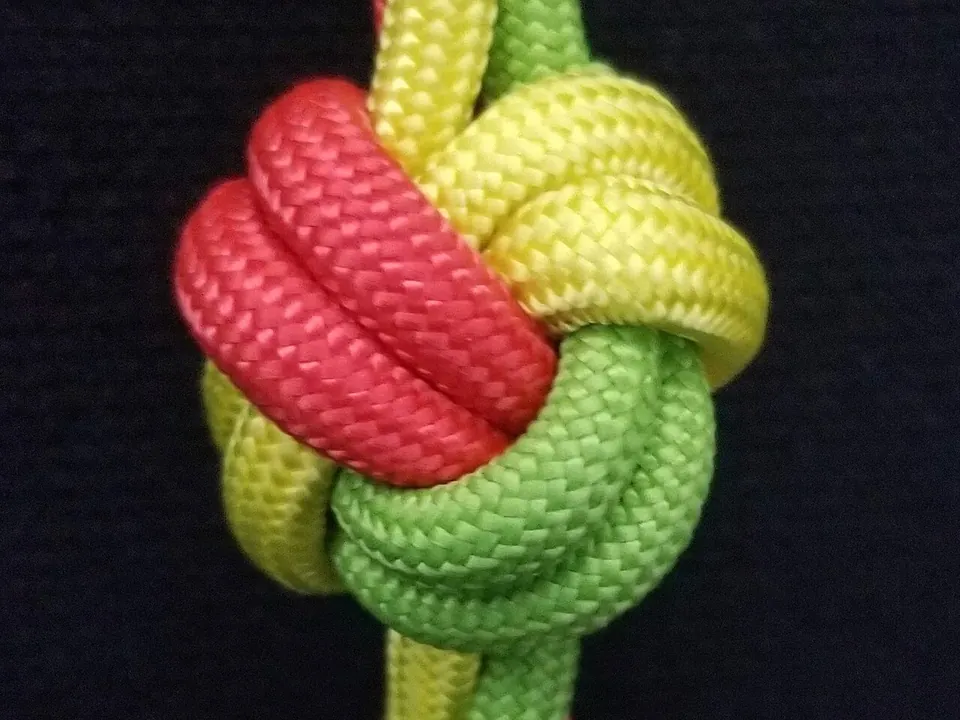
Makes a doubled, fuller version of the single diamond with a three-strand rope's own strands, some way from the end; used as a handhold or stopper on side ropes, bell ropes, man ropes and lanyard ends.
HardNo ABoK numberSailing and boatingDecoration and macramé
Unlay the strands for a good length, as far as the spot where the knot is to sit.
Bend each strand down alongside the standing part to make three bights, and hold the ends together with the rope in one hand.
Tie a single diamond: lead each strand OVER its neighbour, then UP through the bight beyond it.
Leave the strands unlaid; if the single knot has been drawn up, open it out with a marlinespike.
Lead the first two strands in turn alongside their own parts (Öhrvall: on the inner side) through two more single bights, so that their ends emerge at the centre of the knot's upper face.
Take the third strand through two bights that are already doubled and bring it out at the top as well.
Haul the strands taut, then either lay them up again to carry on the rope or seize the ends together and cut them off.
Making a handhold or stopper fuller than the single diamond partway along a rope, using the rope's own strands (side ropes, bell ropes, man ropes, lanyard ends).
When
Unknown; it is described in Darcy Lever's (1760?–1837) book and by Dana in 1841.
Who devised it
Unknown.
Where the name comes from
The sources do not explain the name; 'double' refers to the strands following the single diamond knot round a second time.
Its story
The double diamond knot is worked with a three-strand rope's own strands by leading them round the path of a single diamond knot a second time; it sits wherever it is wanted along the rope rather than at the end. Darcy Lever's The Young Sea Officer's Sheet Anchor gives it for the same jobs as the single knot (bell ropes, side ropes, jib guys) and has the rope laid up again afterwards as far as the place for the next knot; R. H. Dana describes the same method in 1841 and William Brady in 1847, Brady adding that a marlinespike is used to open up the strands. The handbook edited by Hasluck in 1907 lists it, together with a few neighbouring knots, among those used on lanyard ends, man ropes, ridge ropes and yoke lines. In 1916 the Swede Hjalmar Öhrvall describes the double diamond in his own way and counts it as the same knot as his doubled 'fallrepsknop' begun with a crown, in the form where the strands are finally brought up through the centre.