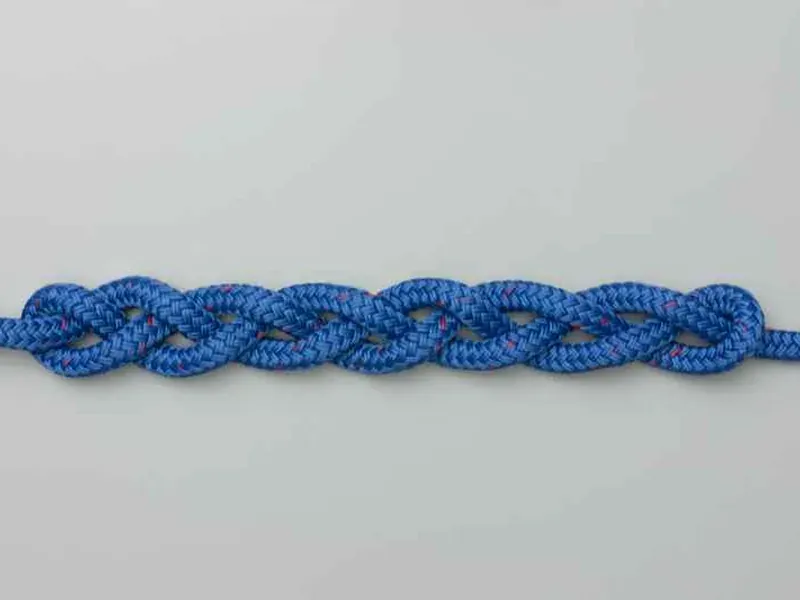
Braids a single rope like a plait of hair by folding it into a bight to make three strands; it shortens the rope, thickens a thin cord where it will be gripped, and serves as decoration.
MediumABoK 2950Decoration and macraméLoads and everyday jobs
Fold the rope into a bight as long as the braid you want and bring the working end alongside it, so that the two legs of the bight and the working end lie side by side as three strands.
Take one of the outer strands OVER the centre strand and lay it in the middle.
Take the outer strand on the other side OVER the new centre strand and lay it in the middle.
Keep bringing the outer strand from each side in turn OVER the centre strand.
As you braid, the strands twist together at the unbraided end of the bight; keep clearing them by passing the working end through the first loop of the bight again and again.
When you reach the end of the bight, pass the working end through the last loop to lock the braid, and tighten it.
Taking up spare length in a rope; thickening a thin cord to make it easier to grip; decoration.
When
Unknown; it is described by 1907 at the latest, in Hasluck's book, as a way of shortening rope.
Who devised it
Unknown.
Where the name comes from
English sources call it the 'twist knot' (Hasluck), the 'twist or plait knot' (Jutsum), and the 'twist' or 'double chain' (Verrill); in Swedish it is 'treflätad platting', a three-strand plait (Öhrvall).
Its story
This is a three-strand braid made with a single rope: the rope is folded into a long bight and the working end is braided with the two legs of the bight as if plaiting hair. Hasluck (1907) describes it as the 'twist knot', a way of shortening a rope; he says it is both ornamental and useful, thickening a thin cord so that it does not cut the hand where it is hauled on. Jutsum (1914) calls it the 'twist or plait knot' and Verrill (1917) the 'twist' or 'double chain'; Verrill adds that Mexicans and Westerners braid bridles and headstalls from leather in the same way, slitting the strap lengthwise so that its ends stay uncut. Öhrvall (1916) gives the Swedish name 'treflätad platting' (three-strand plait), and Animated Knots says that, tied tightly, it can enlarge the end of a cord such as a light-switch pull.