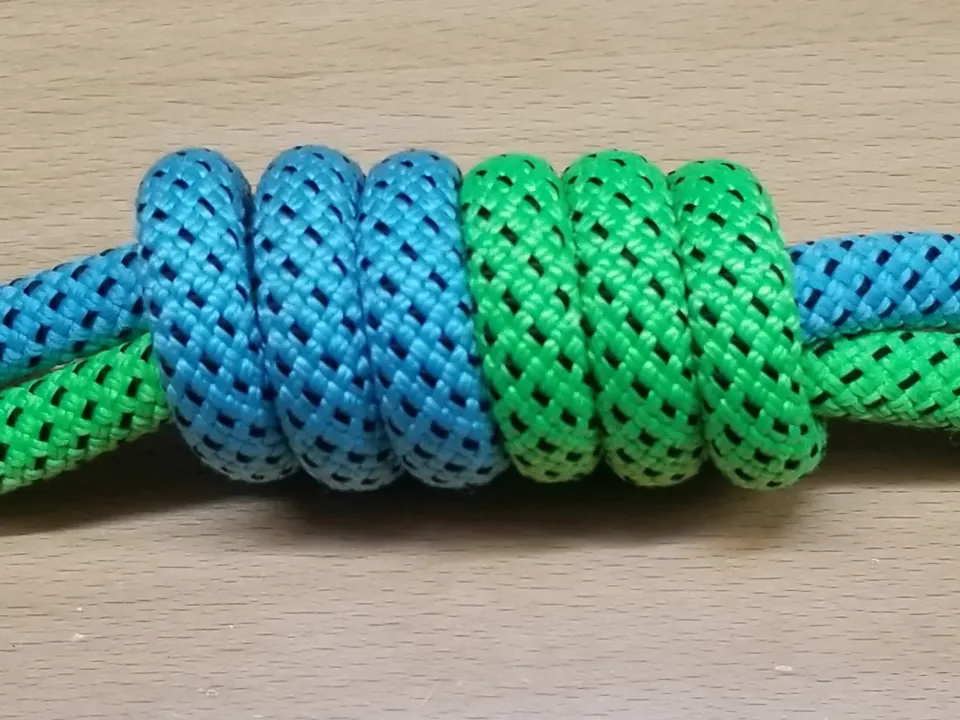
Makes a permanent join between two ropes or closes a single cord into a loop; it is used for Prusik and anchor loops in slick or stiff cord such as Dyneema, Spectra or aramid, and by anglers to join smooth lines.
MediumNo ABoK numberClimbingSearch and rescueTree workFishing
Life safety: This knot is used in climbing, rescue or tree work. This app does not replace hands-on training; for life-safety work, practise under an instructor.
Bring the two rope ends in from opposite sides and lay them alongside each other so they overlap; leave plenty of tail.
Take the first working end three complete turns around both ropes together.
Feed that working end back through all three turns, arrange the turns so none rides over another, and snug this half down hard before touching the other.
Repeat with the second working end: three turns around both ropes, back through those turns, then tighten.
Haul the standing parts apart so the two halves slide toward each other and jam together; keep the tails long.
Keeping knots with fewer turns from pulling through in slick, stiff material (baleen in the past, HMPE and aramid cord today).
When
By about 1700 at the latest: three-turn fisherman's knots in baleen recovered near Nuuk have been radiocarbon dated to that time.
Who devised it
Unknown; the Greenland Inuit used it in baleen fishing lines. Pieter van de Griend argued that it was an Inuit development of their own.
Where the name comes from
From the three turns in each overhand knot, making it the three-turn version of the fisherman's knot. Knots 3D also uses the name Triple Fisherman's Bend.
Its story
The triple fisherman's knot joins two rope ends with a pair of overhand knots, each made with three turns around the other rope's standing part; the only change from the double fisherman's is that third turn in each half. Drawing on Turner and van de Griend's 1996 book, Wikipedia says that Inuit fishermen used multi-turn fisherman's knots in lines of baleen, and that three-turn examples recovered near Nuuk have been radiocarbon dated to around 1700. Knots 3D links these finds to the Greenland Inuit, notes that a piece which reached the National Museum of Denmark from Disko Bay in 1854 also bears three-turn fisherman's knots, and reports that Pieter van de Griend saw them as the Inuit's own invention, not something learned from visiting seamen. Climbers, tree workers and rescuers now recommend it for slick HMPE or aramid cords such as Dyneema or Spectra: Wikipedia explains that above roughly 15 kN the cover of such cord can part where the knot sits and let the slippery core escape, and the extra turn delays this until a slightly higher load.
For joins you will need to untie later, or where the join will be pulled across the ground or over edges and may catch; rescue guidance prefers the flat overhand bend there.
Weakness
Once loaded it jams so hard that untying it by hand is close to impossible; the third turn improves grip, not breaking strength, and at high loads the cover of slick sheathed cord can part and the core slide out of the knot.