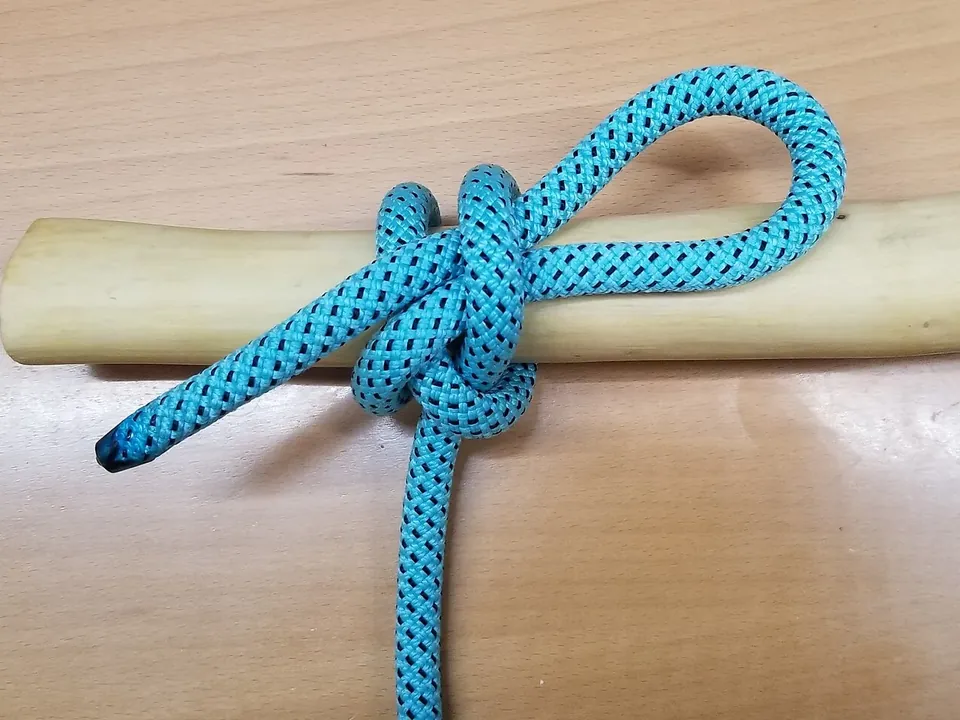
Ties a rope temporarily to a post, rail or spar with two crossing turns; because the final tuck is a bight, it releases when the end is pulled, and it can also close the neck of a sack.
MediumNo ABoK numberSailing and boatingLoads and everyday jobs
Tying a rope temporarily to a post, rail or spar so that one pull frees it; closing the neck of a sack so that it can be opened quickly.
When
Unknown; no date appears in the sources.
Who devised it
Unknown.
Where the name comes from
The base knot is named after the weighted rope along the bottom of a net (the ground-line); 'slipped' means the final tuck is made with a bight.
Its story
Here the ground-line hitch is finished with a bight rather than the end, so a pull on the tail undoes it. The base knot takes its name from the weighted rope that runs along the bottom of a gillnet (Wikipedia); drawing on Ashley, Knots 3D says cod fishermen tied the short branch lines of their trawls onto the main bottom rope with it, and that American cavalry troopers and westward settlers used it to tether horses along a line stretched between a pair of posts or trees. Katamarans suggests it for fastening fenders to a boat's guardrail and adds that forming a bight before the final tuck gives a quick-release form. According to Knots 3D, the slipped form can also close the neck of a bag or sack, and in that role it counts among the binding knots known as miller's knots.