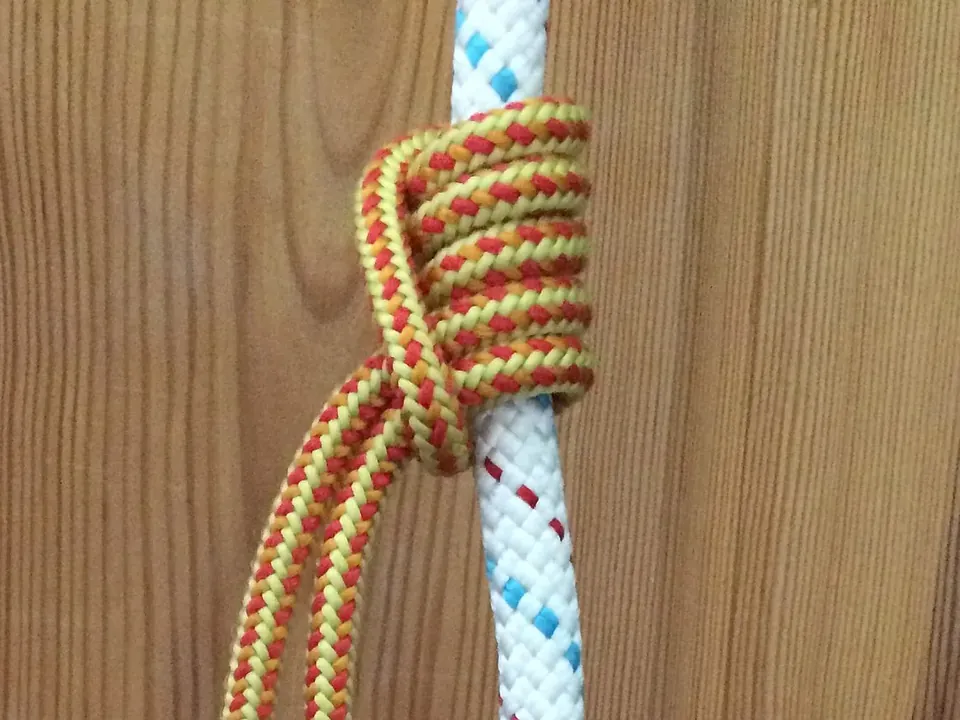
A one-way grip for tree climbing, tied onto the climbing line with a short friction cord that has an eye at each end; it locks under load and slides when unloaded.
MediumNo ABoK numberTree work
Life safety: This knot is used in climbing, rescue or tree work. This app does not replace hands-on training; for life-safety work, practise under an instructor.
Leave one leg of a short friction cord with an eye at each end beside the climbing line; you will wrap with the other leg.
With that leg, take four turns around the climbing line, each one just above the one before.
After the fourth turn, bring the wrapping leg back down along the outside of the turns.
Just below the turns, take one more turn around the line in the opposite direction with the same leg and close it as a half hitch, so that both legs leave the bottom of the hitch together.
Bring the two eyes together in front and clip them into a carabiner.
Dress the turns neatly and load the hitch only through the carabiner, from one direction.
Controlled climbing and descent in trees: a one-way grip that locks under load and slides along the line when unloaded.
When
First published in April 1998, in Arborist News (Knots 3D).
Who devised it
Credited to the German tree climber Bernd Strasser (Knots 3D, NetKnots).
Where the name comes from
From a region of Germany near where Strasser lives (Knots 3D).
Its story
The Schwabisch hitch is a one-way friction hitch that arborists tie onto their climbing line. According to Knots 3D it was first published in Arborist News in April 1998 and is credited to Bernd Strasser, a German climber who has won the International Tree Climbing Championship (ITCC) many times; its name comes from a region of Germany near his home. NetKnots presents it as a closed system in which a short friction cord is wrapped around a thicker climbing line and clipped with a carabiner; for ease of release it comfortably beats a taut-line hitch but falls a little short of a French prusik, and once a descent is over it holds the line firmly again.