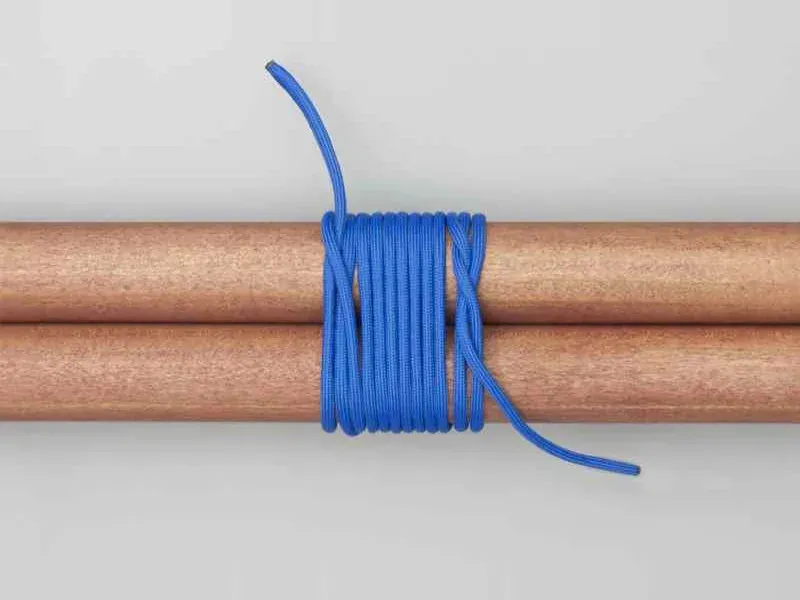
To make one long pole from two shorter ones overlapped end to end; for flagpoles, pioneering structures and camp gadgets.
When
Unknown; no date appears in the sources.
Who devised it
Unknown.
Where the name comes from
The sources do not explain the name. Knots 3D also gives 'vertical lashing'; Thurman calls it 'Sheer Lashing Mark II' (Scout Pioneering); the nautical counterpart is 'gammon' (Wikipedia).
Its story
The round lashing binds two overlapping poles side by side to make one longer pole; it is common in Scouting and in pioneering structures built from spars, such as flagpoles. Scout Pioneering reports that John Thurman's Pioneering Principles names the same lashing 'Sheer Lashing Mark II', and that Thurman prefers to begin it with a timber hitch rather than a clove hitch to make it stiffer. Animated Knots writes that it is similar to the lashing Ashley gives for scaffolding (#2103). At sea, 'gammon' is the word for a rope or iron lashing that secures a mast to a vessel; Wikipedia gives this as the nautical counterpart of the round lashing.
On shear legs that must open out or on poles that cross each other; use a shear lashing or a square lashing there.
Weakness
It is hard to make tight enough and has no frapping turns; a single lashing acts as a pivot, so at least two lashings and, if needed, wedges are required.