Ocean plait mat TR
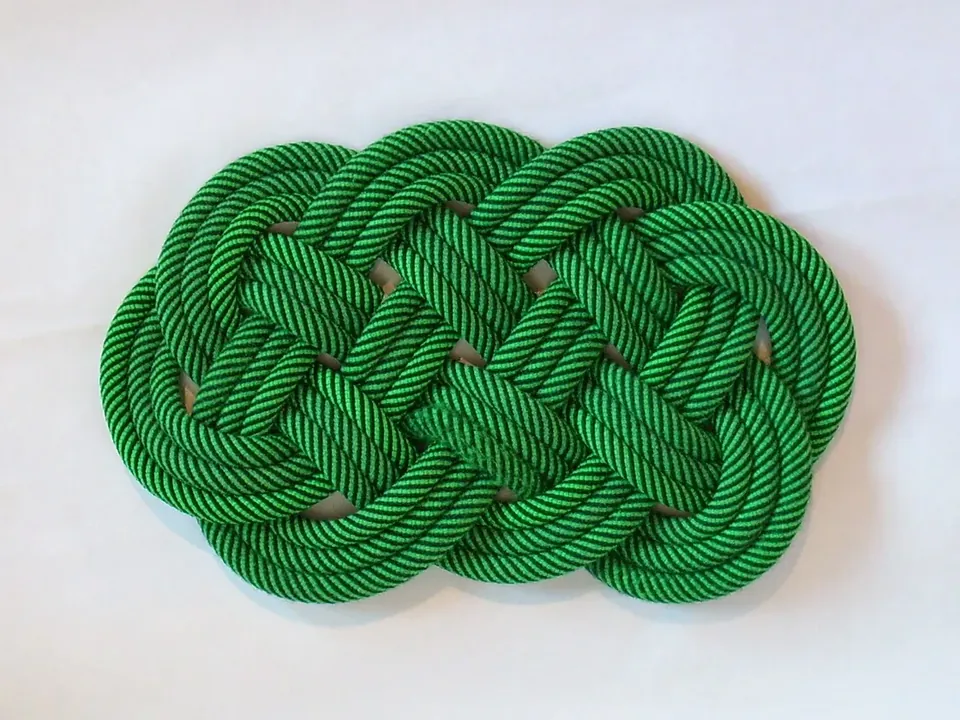
Ocean plait mat, tied and tightened

Decorative

Ocean plait mat

Weaves one line into a flat, oval mat; small ones serve as table mats and hot pads, large ones as doormats and stair treads, and aboard ship it protected wooden edges where a rope rubbed.

Medium ABoK 2243 Decoration and macraméSailing and boating

The animation and practice area for this knot are not ready yet. Available now: Overhand knot, Figure-eight knot, Double overhand knot, Stevedore knot, Ashley's stopper knot, Heaving line knot, Monkey's fist, Slip knot, Sheet bend, Double sheet bend, Carrick bend, Fisherman's knot, Double fisherman's knot, Water knot, Flemish bend (figure-eight bend), Offset overhand bend, Zeppelin bend, Hunter's bend, Butterfly bend, Blood knot (barrel knot), Albright special, Nail knot, Harness bend, Heaving line bend, Racking bend, Reever knot, Simple Simon over, Beer knot, Adjustable bend, Bowline, Double bowline, Water bowline, Bowline on a bight, Spanish bowline, Yosemite bowline, Cowboy bowline, Running bowline, Eskimo bowline, Figure-eight loop, Directional figure eight, Double figure-eight loop, Figure-of-nine loop, Alpine butterfly loop, Overhand loop, Angler's loop (perfection loop), Dropper loop, Farmer's loop, Artillery loop (manharness knot), Fireman's chair knot, Honda knot, Zeppelin loop, Bimini twist, Clove hitch, Slipped clove hitch, Cow hitch (lark's head), Half hitch, Two half-hitches, Round turn and two half-hitches, Anchor bend (fisherman's bend), Timber hitch, Killick hitch, Rolling hitch, Magnus hitch, Taut-line hitch, Buntline hitch, Cleat hitch, Highwayman's hitch, Tumble hitch, Mooring hitch, Halter hitch, Pile hitch, Constrictor knot, Strangle knot, Trucker's hitch, Siberian hitch, Marlinespike hitch, Pipe hitch, Tensionless hitch, Munter hitch, Cat's paw, Ground-line hitch, Becket hitch, Halyard bend, Lobster buoy hitch, Barrel hitch, Bale sling hitch, Swing hitch, Prusik knot, Klemheist knot, Bachmann knot, Autoblock (French prusik), Blake's hitch, Distel hitch, Adjustable grip hitch, Reef knot (square knot), Granny knot, Thief knot, Miller's knot, Packer's knot, Boa knot, Transom knot, Sheepshank, Chain sinnet, Square lashing, Diagonal lashing, Shear lashing, Common whipping, Sailmaker's whipping, Improved clinch knot, Palomar knot, Uni knot, Trilene knot, Arbor knot, Turle knot, Turk's head knot, Carrick mat, Wall and crown knot, Matthew Walker knot, Diamond knot, Chinese button knot, Celtic button knot, Pan Chang knot, Good luck knot, True lover's knot, Friendship knot.

How to tie it

  1. Tie a loose overhand knot leaving one short and one long end, and draw its two loops out long, both pointing the same way.
  2. Twist each loop so that it makes a crossing, and lay the two loops across each other.
  3. Weave the short end through the pattern to the other side, then weave the long end through as well to lock the single-strand pattern.
  4. Lead the long end round the whole pattern a second time, keeping it beside and parallel to the first round.
  5. Keep following in the same way until the mat is as thick as you want; Animated Knots shows four rounds, Knots 3D shows three as the usual number.
  6. Work the whole mat tight, step by step, so that no gaps remain between the rounds.
  7. Cut the ends, hide them under a round on the underside of the mat, and fix them to the neighbouring round by stitching or seizing.

The method was checked against: Animated Knots (Grog): Ocean Plait Mat, Knots 3D: Ocean Plait.

Origin and story

Why it was needed
Letting a mat take the wear where a rope rubbed on wooden edges aboard ship and making use of worn-out rope; today, making table mats, doormats and stair treads.
When
Unknown; Ashley recorded it as #2243 in The Ashley Book of Knots in 1944.
Who devised it
Unknown; Knots 3D writes that mats of this kind were made aboard sailing ships.
Where the name comes from
Ashley did not invent the name 'Ocean Plat'; Knots 3D says he borrowed it from an example in the South Kensington Museum's collection.

Its story

Clifford W. Ashley listed the ocean plait as #2243 in The Ashley Book of Knots, under the spelling 'Ocean Plat'. Knots 3D says Ashley did not invent that name but borrowed it from an example held by the South Kensington Museum, and that he pointed out the mat is built just like the Chinese (flat) knife lanyard knot, the only difference being where the ends go. According to Knots 3D, sailing ships put such mats at spots where a rope chafed against a wooden edge, so the mat wore out instead of the wood; old sheets and halyards were reused as doormats rather than discarded, and long calms gave crews the time for this work. Animated Knots places it in a big group of symmetrical mats that are woven from the ends of the line.

Source: Wikipedia: The Ashley Book of Knots, Knots 3D: Ocean Plait, Animated Knots (Grog): Ocean Plait Mat.

No sourced Turkish name yet.

Where not to use it
It is not for tying a rope to anything or carrying a load; the sources describe it only as a mat, pad and chafe guard.
Weakness
It needs a surprising amount of line for the size of the finished mat (Knots 3D: a large one can take four times its own length); heavy rope tends to lose its shape during the weaving, and a mat stopped at two rounds may not lie flat.
Similar and alternative knots

Sources and verification

  • The card was written in our own words from Wikipedia and Wikidata data; the tying method has not yet been checked against two sources.