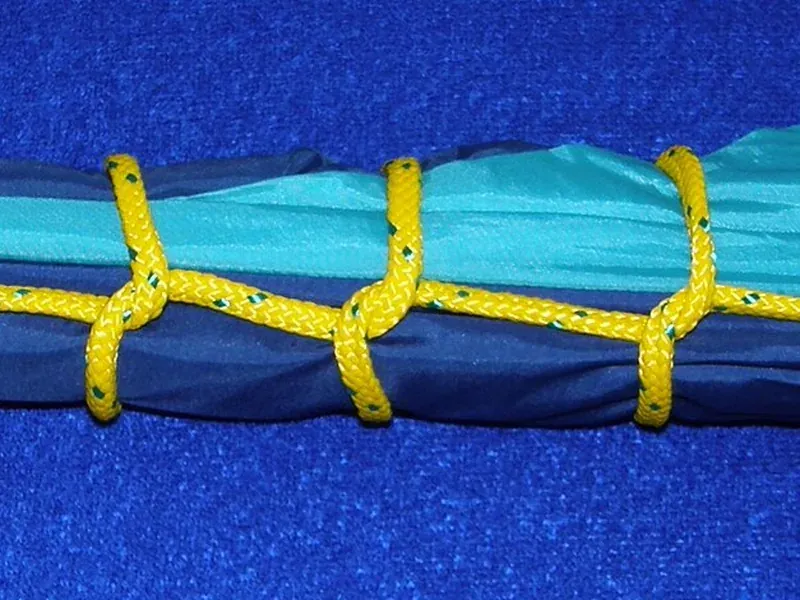
Wraps an object or bundle along its length with spaced turns, locking each turn with a small overhand knot; used to lace a sail to a gaff or to hold long bundles together.
EasyABoK 3115Sailing and boatingLoads and everyday jobs
To lace a sail to a gaff and to hold long bundles, or the canvas strips wound round a rope, with spaced turns, so that the rest still holds if one turn parts.
When
Unknown; Hasluck describes it in 1907 as the improved chain knot.
Who devised it
Unknown.
Where the name comes from
The sources do not explain the name; Hasluck calls winding small stuff (marline) round a rope this way marling, and in German the work is called Marlen.
Its story
The marline hitch wraps an object along its length with spaced turns and locks each turn with a small overhand knot. Hasluck described it in 1907 under the name improved chain knot: it was used on yachts to lace sails to the gaff, and because every turn stands on its own knot, the rest holds even if the cord parts at one point. The same book says that the old tarred canvas strips wound round a rope were held down the same way, with small stuff in spaced turns knotted at every turn. The German Wikipedia notes that before cable ties existed, cable bundles were also tied together with this hitch.
Where a single-point, load-bearing hitch is needed; this one is for wrapping something along its length.
Weakness
It cannot stand alone: it needs a knot to start it and a closing knot, for example a constrictor, to finish it, and if the turns are tied as half hitches by mistake it holds less firmly.