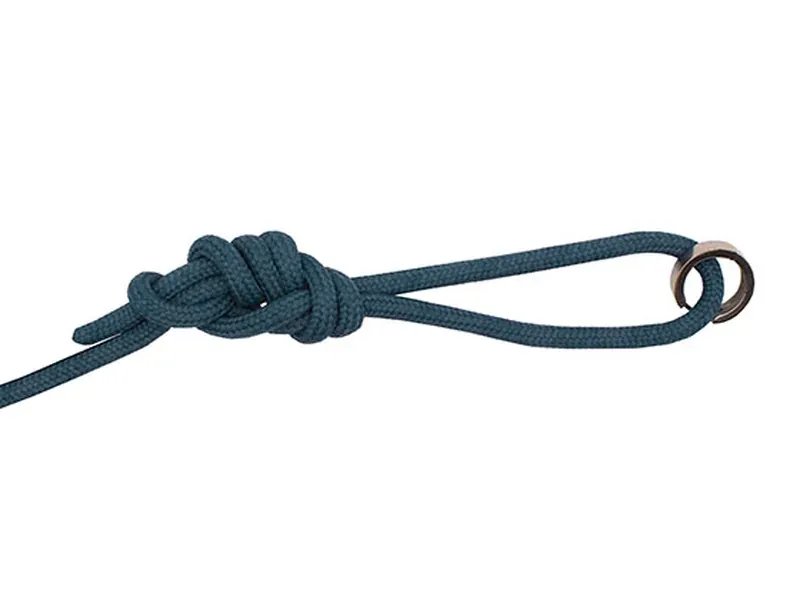
Run the line's end through the eye of your hook, lure or fly and double it back alongside the standing part; for a plain open loop, just fold the end of the line double.
Fold the doubled line back on itself to make a loop about 5–8 cm above the end of the bight.
Push your index finger into the far end of this loop and twist it three to five times, always the same way, while your other hand holds the hook and the standing part.
Pass the hook or lure (or, for an open loop, the end of the bight) through the twisted loop.
Moisten the knot, pull the standing part and the working end one way and the hook or loop the other way to tighten it, and trim the end.
Leaving an open loop at the line's end so the lure or fly moves more freely; doubling braided line before joining it to a leader.
When
Unknown; no date of origin appears in the sources.
Who devised it
Unknown.
Where the name comes from
Unknown; the sources do not say where the name comes from.
Its story
The king sling is a fishing knot that leaves an open loop at the line's end. When NetKnots added it to its loop knots in December 2012, it wrote that anglers like such knots on the theory that a loop lets the lure or fly move more naturally, and that the king sling is reputed to be stronger than the other loops. On Tactical Bassin', a bass-fishing blog, Matt Allen wrote in 2015 that he uses it instead of a snap on big swimbaits and on walk-the-dog topwater lures. In 2018 Salt Strong presented it as a simpler and quicker way than the spider hitch to double braided line before tying it to a leader.
Terminal connections that need the highest strength; NetKnots says no loop knot matches the Palomar, and in a North American Fisherman test the NanoFil knot did better.
Weakness
Salt Strong says it is not the strongest loop knot; NetKnots says it can be tied in monofilament only up to about 50 lb (23 kg) test.