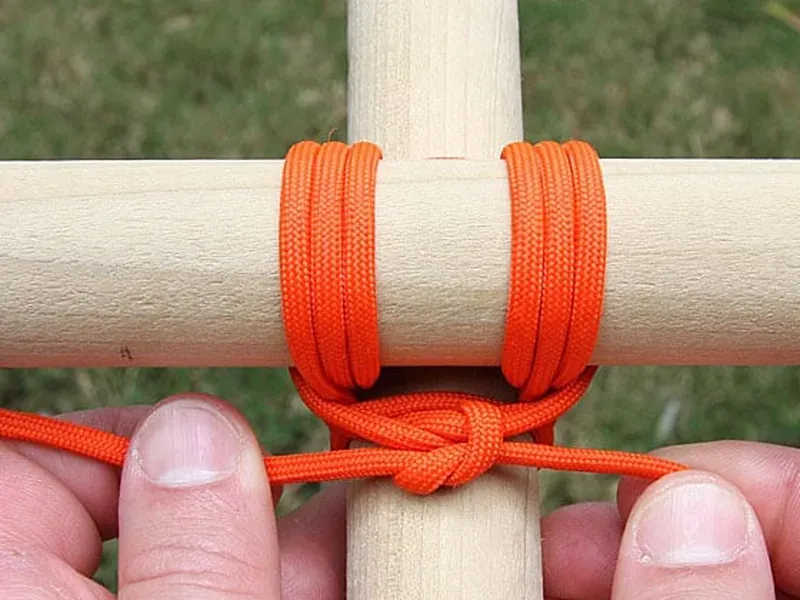
Binds two poles that cross at a right angle; because both ends of the rope are worked at the same time, it is quicker to tie than the traditional square lashing.
Set the poles at right angles and fold the rope in half.
Loop the rope's midpoint around the vertical pole directly beneath the horizontal pole, bringing both ends round to the front.
Bring both ends together upward, passing OVER the horizontal pole on its front side, then take them behind the vertical pole in opposite directions, one to each side, to complete the first wrapping turn.
Make the second wrapping turn the same way going down and the third going up again, pulling both ends tight after each turn.
After the third turn, lead the ends between the poles in opposite directions and take frapping turns around the wrapping turns, pulling each one tight.
Finish by tying the two ends together with a reef knot.
Lashing two poles at right angles faster than the traditional method: with both ends of the rope worked at once, neither hand has as much rope to haul through.
When
Unknown; after seeing it in Japan, John Thurman included it in Pioneering Principles, his 1962 book.
Who devised it
Unknown; John Thurman, former camp chief at Gilwell Park, saw it in Japan and brought it to Scouting.
Where the name comes from
The sources do not state the origin of the name outright; Knots 3D says Thurman saw the method on a trip to Japan. 'Mark II' is the second of three forms (Mark I, II, III) that differ in how they start.
Its story
The Japanese square lashing owes its place in Scouting to John Thurman, a well-known figure in British Scouting and former camp chief at Gilwell Park: Knots 3D says he came across the method while touring Japan, was struck by how fast it could be tied, and included it in Pioneering Principles, his 1962 book. The Pioneering merit badge pamphlet written by Adolph Peschke (1993 edition) says the lashing reached Scouting in the United States by way of Wood Badge courses in England. In a story retold on the Scout Pioneering site, Peschke asked his pioneering staff at the 1993 National Jamboree to use only this lashing; the staff were hesitant at first, but once they knew it they wondered why they had spent years on the old method that starts and ends with a clove hitch. According to Knots 3D the lashing was also added to the Scout Handbook in 2016.
Where the poles do not cross at right angles; where the lashing must not slide along the upright pole, the sources point to the Mark III, which starts with a clove hitch.
Weakness
With no starting clove hitch the lashing can slide along the upright pole, and the finishing reef knot can capsize, which is why Findley adds half hitches.