Filipino diagonal lashing TR
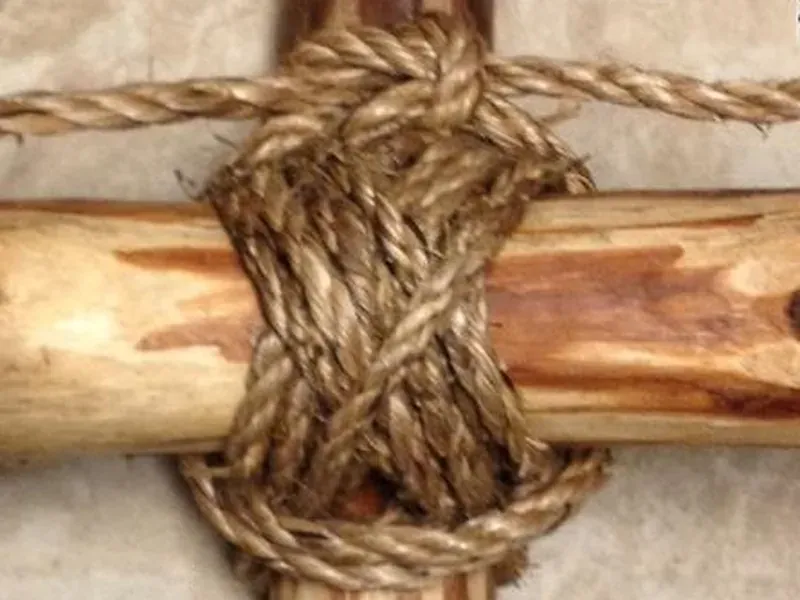
Filipino diagonal lashing, tied and tightened

Lashing

Filipino diagonal lashing

Binds two poles that cross but do not touch, drawing them together with a lark's head tied in the middle of the rope and wrapping with both ends at once; quicker to tie than the traditional diagonal lashing.

Medium No ABoK number Camping and scouting

The animation and practice area for this knot are not ready yet. Available now: Overhand knot, Figure-eight knot, Double overhand knot, Stevedore knot, Ashley's stopper knot, Heaving line knot, Monkey's fist, Slip knot, Sheet bend, Double sheet bend, Carrick bend, Fisherman's knot, Double fisherman's knot, Water knot, Flemish bend (figure-eight bend), Offset overhand bend, Zeppelin bend, Hunter's bend, Butterfly bend, Blood knot (barrel knot), Albright special, Nail knot, Harness bend, Heaving line bend, Racking bend, Reever knot, Simple Simon over, Beer knot, Adjustable bend, Bowline, Double bowline, Water bowline, Bowline on a bight, Spanish bowline, Yosemite bowline, Cowboy bowline, Running bowline, Eskimo bowline, Figure-eight loop, Directional figure eight, Double figure-eight loop, Figure-of-nine loop, Alpine butterfly loop, Overhand loop, Angler's loop (perfection loop), Dropper loop, Farmer's loop, Artillery loop (manharness knot), Fireman's chair knot, Honda knot, Zeppelin loop, Bimini twist, Clove hitch, Slipped clove hitch, Cow hitch (lark's head), Half hitch, Two half-hitches, Round turn and two half-hitches, Anchor bend (fisherman's bend), Timber hitch, Killick hitch, Rolling hitch, Magnus hitch, Taut-line hitch, Buntline hitch, Cleat hitch, Highwayman's hitch, Tumble hitch, Mooring hitch, Halter hitch, Pile hitch, Constrictor knot, Strangle knot, Trucker's hitch, Siberian hitch, Marlinespike hitch, Pipe hitch, Tensionless hitch, Munter hitch, Cat's paw, Ground-line hitch, Becket hitch, Halyard bend, Lobster buoy hitch, Barrel hitch, Bale sling hitch, Swing hitch, Prusik knot, Klemheist knot, Bachmann knot, Autoblock (French prusik), Blake's hitch, Distel hitch, Adjustable grip hitch, Reef knot (square knot), Granny knot, Thief knot, Miller's knot, Packer's knot, Boa knot, Transom knot, Sheepshank, Chain sinnet, Square lashing, Diagonal lashing, Shear lashing, Common whipping, Sailmaker's whipping, Improved clinch knot, Palomar knot, Uni knot, Trilene knot, Arbor knot, Turle knot, Turk's head knot, Carrick mat, Wall and crown knot, Matthew Walker knot, Diamond knot, Chinese button knot, Celtic button knot, Pan Chang knot, Good luck knot, True lover's knot, Friendship knot.

How to tie it

  1. Double the rope at its middle; take the bight behind both poles along one diagonal where they cross and pass both ends through it to form a lark's head (cow hitch).
  2. Pull both ends together firmly to draw the poles towards each other until they touch.
  3. Holding both ends together, wrap one turn around the poles along the other diagonal, adding a second turn for extra strength if you like; since the rope is doubled, each turn counts as two wraps.
  4. Pass the ends behind the rear pole to change direction and wrap one or two more turns along the first diagonal, pulling each turn tight.
  5. Separate the ends and take one OVER and the other UNDER the front pole, so that they run in opposite directions; then pass two or three frapping turns between the poles, round the wraps, pulling each one hard.
  6. Finish by tying the two ends together with a tight reef (square) knot.

The method was checked against: Scout Pioneering: Filipino Diagonal Lashing, Scouting Resources UK: Knots – Lashings – Filipino Lashing.

Origin and story

Why it was needed
To draw together and bind two poles that cross without touching, or that spring apart (such as the cross brace of a trestle), more easily and quickly than with the traditional diagonal lashing.
When
Unknown; no date appears in the sources.
Who devised it
Unknown; according to Scout Pioneering, the common way of tying it today is the method in Gerald Findley's Rope Works Plus.
Where the name comes from
The origin of the name 'Filipino' is not in the sources; it is called diagonal because its wraps run across the poles at a slant.

Its story

The Filipino diagonal lashing is a quick form of the diagonal lashing used in scout pioneering, where structures are built from poles: the traditional method draws the poles together with a timber hitch, whereas this one starts with a lark's head (cow hitch) tied in the middle of the rope, and both ends are wrapped together. Scout Pioneering, the site of an American scouting volunteer, calls it simpler and far quicker while doing the job equally well, and says that many who tie it have adopted the clear method from Gerald Findley's Rope Works Plus. Scouting Resources in Britain treats it as an option suited to light constructions and recommends a proper diagonal lashing where there is doubt about it or it will take a large strain. Where the name 'Filipino' comes from is not in the sources.

Source: Scout Pioneering: Filipino Diagonal Lashing, Scouting Resources UK: Knots – Lashings – Filipino Lashing.

No sourced Turkish name yet.

Where not to use it
In structures that will take a heavy load, or where you are unsure of it; a British scouting source recommends a traditional diagonal lashing in that case.
Weakness
One source considers it suitable only for light structures, and unless every wrapping and frapping turn is pulled tight the lashing will not hold the poles firmly.
Similar and alternative knots

Sources and verification

  • The card was written in our own words from Wikipedia and Wikidata data; the tying method has not yet been checked against two sources.