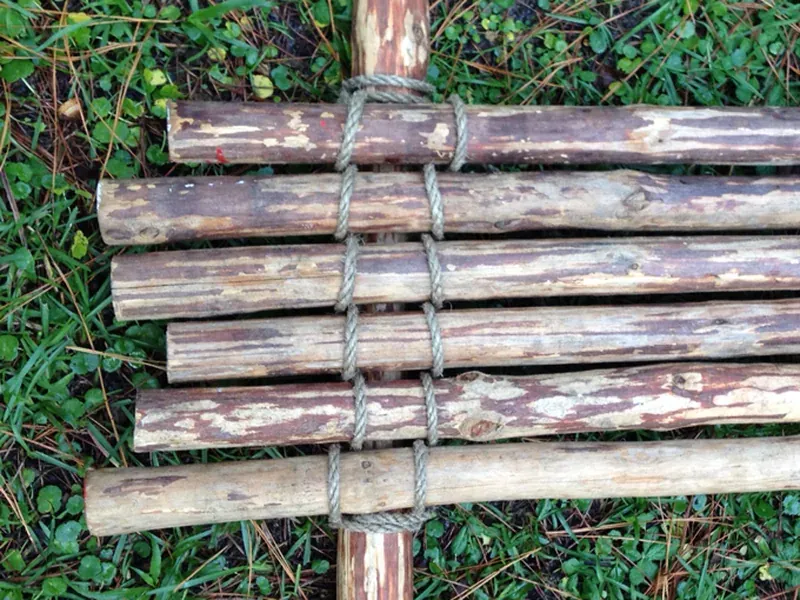
Start with a clove hitch round the support pole, just inside the spot where the first decking pole will rest, and lock the short end by twisting it round the long part, following the rope's lay.
Form a bight in the rope's long part and lay it OVER the first decking pole, inside the support.
Pass the bight UNDER the support pole to the outside.
Drop the bight's eye OVER the end of the first decking pole where it sticks out beyond the support.
Pull the long part, which comes up on top of the floor between the first and second decking poles, to tighten both loops.
Do the same at every decking pole down to the last one; the other support can be lashed at the same time or afterwards.
Finish at the far end of the support with two tight half hitches (a clove hitch).
Quickly binding many parallel decking poles to two supports with one rope, instead of tying every crossing on its own, to get a flat surface.
When
Unknown; according to The Bear Essentials the earliest written description found dates from 1999 (Gerald L. Findley, Rope Works). The double-loop form was published by Scout Pioneering in 2013.
Who devised it
Unknown; The Bear Essentials places it in the pioneering programme of American Scouting.
Where the name comes from
The sources do not explain the name as such; according to The Bear Essentials the common modern form is called 'double' because each decking pole is held by two loops, one on the inside and one on the outside of the support; Scout Pioneering also calls this form the 'improved floor lashing'.
Its story
The floor lashing is used in the pioneering programme of American Scouting to build tables, raised platforms, rafts and walkways. The Bear Essentials found no record of it before the 20th century; the oldest written account they found is a 1999 knotboard reader by Gerald L. Findley of Rope Works, which teaches a version with one loop per pole and advises laying the thick ends of the decking poles in alternating directions so that their taper evens out. In 2013 Scout Pioneering published the 'double floor lashing', which holds each decking pole with a loop on each side of the support; The Bear Essentials says this has since become the form most taught in Scouting, and The Scout Association in the UK also uses it in a camp-table activity.
Where maximum stiffness is needed at a few joints (a square lashing holds tighter) and, since it has no measured strength, in permanent structures that will carry heavy loads or many people over time.
Weakness
Its hold depends only on the tension in the loops and nothing self-tightens; if one loop slackens the decking shifts, so check every loop for tension before anyone stands on it.