Double Matthew Walker knot TR
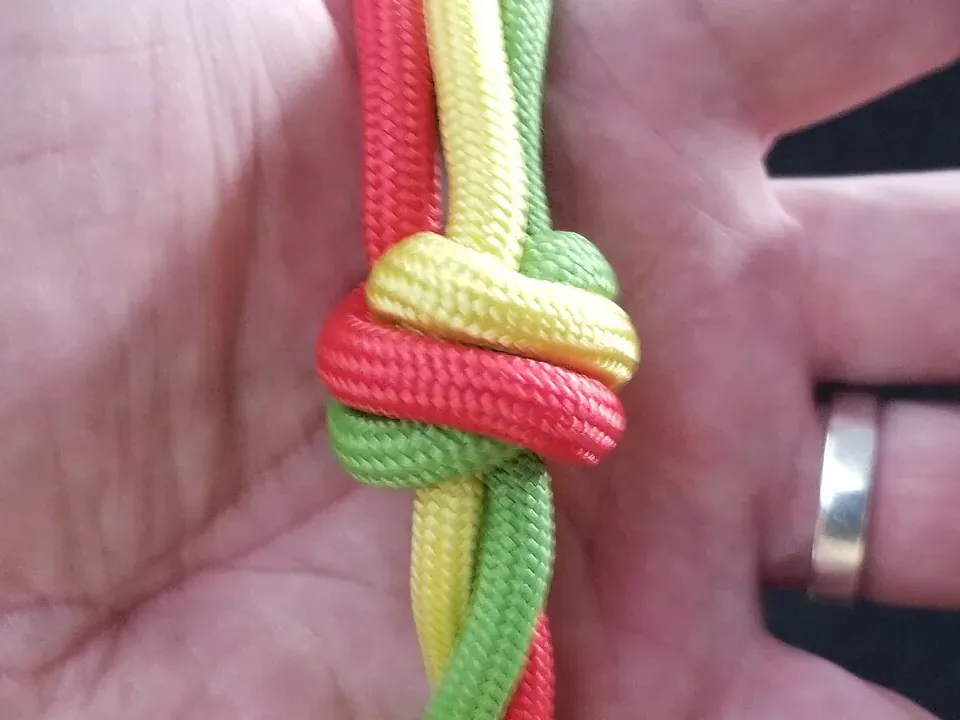
Double Matthew Walker knot, tied and tightened

Stopper · Decorative

Double Matthew Walker knot

Ties a thick stopper knob that will not come undone, using the strands of a laid rope at its end or in its middle; today it is made mostly for decoration.

Hard ABoK 681, 682, 683 Sailing and boatingDecoration and macramé

The animation and practice area for this knot are not ready yet. Available now: Overhand knot, Figure-eight knot, Double overhand knot, Stevedore knot, Ashley's stopper knot, Heaving line knot, Monkey's fist, Slip knot, Sheet bend, Double sheet bend, Carrick bend, Fisherman's knot, Double fisherman's knot, Water knot, Flemish bend (figure-eight bend), Offset overhand bend, Zeppelin bend, Hunter's bend, Butterfly bend, Blood knot (barrel knot), Albright special, Nail knot, Harness bend, Heaving line bend, Racking bend, Reever knot, Simple Simon over, Beer knot, Adjustable bend, Bowline, Double bowline, Water bowline, Bowline on a bight, Spanish bowline, Yosemite bowline, Cowboy bowline, Running bowline, Eskimo bowline, Figure-eight loop, Directional figure eight, Double figure-eight loop, Figure-of-nine loop, Alpine butterfly loop, Overhand loop, Angler's loop (perfection loop), Dropper loop, Farmer's loop, Artillery loop (manharness knot), Fireman's chair knot, Honda knot, Zeppelin loop, Bimini twist, Clove hitch, Slipped clove hitch, Cow hitch (lark's head), Half hitch, Two half-hitches, Round turn and two half-hitches, Anchor bend (fisherman's bend), Timber hitch, Killick hitch, Rolling hitch, Magnus hitch, Taut-line hitch, Buntline hitch, Cleat hitch, Highwayman's hitch, Tumble hitch, Mooring hitch, Halter hitch, Pile hitch, Constrictor knot, Strangle knot, Trucker's hitch, Siberian hitch, Marlinespike hitch, Pipe hitch, Tensionless hitch, Munter hitch, Cat's paw, Ground-line hitch, Becket hitch, Halyard bend, Lobster buoy hitch, Barrel hitch, Bale sling hitch, Swing hitch, Prusik knot, Klemheist knot, Bachmann knot, Autoblock (French prusik), Blake's hitch, Distel hitch, Adjustable grip hitch, Reef knot (square knot), Granny knot, Thief knot, Miller's knot, Packer's knot, Boa knot, Transom knot, Sheepshank, Chain sinnet, Square lashing, Diagonal lashing, Shear lashing, Common whipping, Sailmaker's whipping, Improved clinch knot, Palomar knot, Uni knot, Trilene knot, Arbor knot, Turle knot, Turk's head knot, Carrick mat, Wall and crown knot, Matthew Walker knot, Diamond knot, Chinese button knot, Celtic button knot, Pan Chang knot, Good luck knot, True lover's knot, Friendship knot.

How to tie it

  1. Unlay the laid rope into its strands where the knot is to go; the strands will be laid up again at the end.
  2. Make a loose wall knot with the strands: pass each strand UNDER its neighbour, bring it up through that neighbour's bight, and leave it slack.
  3. Lay each strand alongside the neighbouring strand it is going to follow.
  4. Lead the first strand along the path of the strand beside it, pass it UNDER the third strand, and bring it up through its own bight.
  5. Tuck the other two strands the same way and in the same direction; when done, every strand's bight encloses all three strands, its own end included.
  6. Tighten the knot carefully, drawing up each strand a little at a time until the knob sits evenly.
  7. Lay the strands up again to close the rope and whip the end; if the knot sits at the rope's end, whip the strands together and cut them short.

The method was checked against: Animated Knots: Double Matthew Walker Knot (metin ve fotoğraflı animasyon), Öhrvall, Om knutar (2. baskı, 1916), s. 152–153 (dubbel sjåarknop), Jutsum, Knots, Bends, Splices (1914), s. 36–37, Fig. 71–72.

Origin and story

Why it was needed
A thick stopper knob in laid rope that will not come undone; on older ships it served on the lanyards of topmast rigging, on bunt beckets, and as the rope handles of tubs and buckets.
When
1808 at the latest: according to Ashley, the knot Lever described that year as 'Matthew Walker's knot' is this form; the name double Matthew Walker appears in Alston in 1860.
Who devised it
Unknown; Ashley guesses that the Matthew Walker of the name could have been a master rigger at a British navy dockyard.
Where the name comes from
Who Matthew Walker was is unknown. The name first belonged to this form; when the simpler form took it over, this one came to be called the 'double'. Öhrvall (1916) finds 'double' misleading and also gives the Swedish names turban knot and snake head.

Its story

According to Ashley, the knot Lever described in 1808 as 'Matthew Walker's knot' is this form; Alston called it the double Matthew Walker in 1860. A simpler knot derived from it later took over the original name, and today 'a Matthew Walker' usually means that one. As Animated Knots reports, Ashley (p. 118) counts it the most important knot on board and cites Todd and Whall's Seamanship, for whom the Matthew Walker was nearly the one knot every seaman must know; this knot or its single form once served on the lanyards of topmast rigging, on bunt beckets (rope loops), and as the rope handles of tubs and buckets. The Swedish author Öhrvall (1916) found the name 'double' misleading, since the knot is not a doubling of the single form in the usual sense, and proposed calling it the turban knot. Animated Knots observes that, decoration aside, it has almost no job on today's yachts.

Source: Wikipedia: Matthew Walker knot (Ashley, ABoK s. 118'den alıntıyla), Animated Knots: Double Matthew Walker Knot, Öhrvall, Om knutar (2. baskı, 1916), s. 152–154.

No sourced Turkish name yet.

Where not to use it
On braided or sheathed rope, whose strands cannot be unlaid and laid up again, and wherever the knot will later need to be untied.
Weakness
It cannot be tied without unlaying and re-laying the rope, nor untied without taking the rope apart; tightening it takes patience, and the end must be whipped as well.
Similar and alternative knots

Sources and verification

  • The card was written in our own words from Wikipedia and Wikidata data; the tying method has not yet been checked against two sources.