Double constrictor knot TR
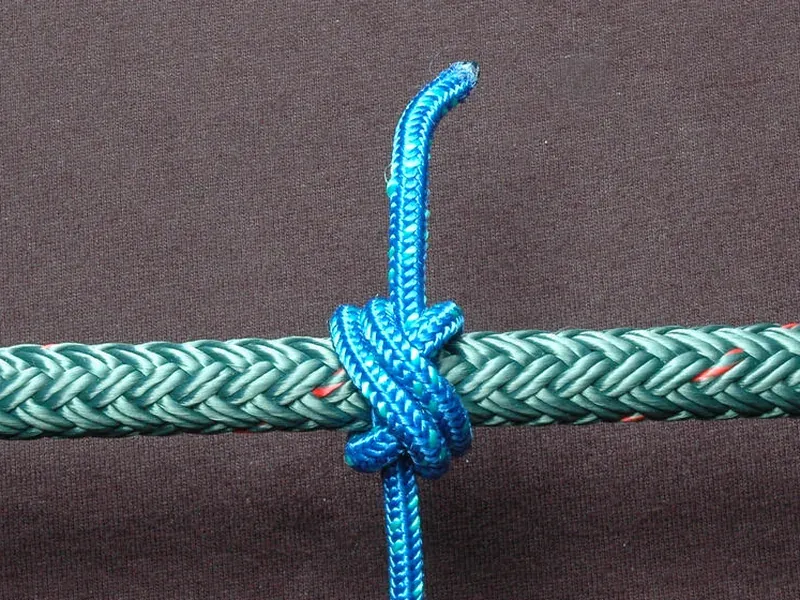
Double constrictor knot, tied and tightened

Binding

Double constrictor knot

Grips a bag or sack mouth, a hose, a rope end or a bundle of sticks even harder and more securely than the constrictor; it is especially useful in slippery or waxed twine.

Medium ABoK 1252 Loads and everyday jobsCamping and scouting

The animation and practice area for this knot are not ready yet. Available now: Overhand knot, Figure-eight knot, Double overhand knot, Stevedore knot, Ashley's stopper knot, Heaving line knot, Monkey's fist, Slip knot, Sheet bend, Double sheet bend, Carrick bend, Fisherman's knot, Double fisherman's knot, Water knot, Flemish bend (figure-eight bend), Offset overhand bend, Zeppelin bend, Hunter's bend, Butterfly bend, Blood knot (barrel knot), Albright special, Nail knot, Harness bend, Heaving line bend, Racking bend, Reever knot, Simple Simon over, Beer knot, Adjustable bend, Bowline, Double bowline, Water bowline, Bowline on a bight, Spanish bowline, Yosemite bowline, Cowboy bowline, Running bowline, Eskimo bowline, Figure-eight loop, Directional figure eight, Double figure-eight loop, Figure-of-nine loop, Alpine butterfly loop, Overhand loop, Angler's loop (perfection loop), Dropper loop, Farmer's loop, Artillery loop (manharness knot), Fireman's chair knot, Honda knot, Zeppelin loop, Bimini twist, Clove hitch, Slipped clove hitch, Cow hitch (lark's head), Half hitch, Two half-hitches, Round turn and two half-hitches, Anchor bend (fisherman's bend), Timber hitch, Killick hitch, Rolling hitch, Magnus hitch, Taut-line hitch, Buntline hitch, Cleat hitch, Highwayman's hitch, Tumble hitch, Mooring hitch, Halter hitch, Pile hitch, Constrictor knot, Strangle knot, Trucker's hitch, Siberian hitch, Marlinespike hitch, Pipe hitch, Tensionless hitch, Munter hitch, Cat's paw, Ground-line hitch, Becket hitch, Halyard bend, Lobster buoy hitch, Barrel hitch, Bale sling hitch, Swing hitch, Prusik knot, Klemheist knot, Bachmann knot, Autoblock (French prusik), Blake's hitch, Distel hitch, Adjustable grip hitch, Reef knot (square knot), Granny knot, Thief knot, Miller's knot, Packer's knot, Boa knot, Transom knot, Sheepshank, Chain sinnet, Square lashing, Diagonal lashing, Shear lashing, Common whipping, Sailmaker's whipping, Improved clinch knot, Palomar knot, Uni knot, Trilene knot, Arbor knot, Turle knot, Turk's head knot, Carrick mat, Wall and crown knot, Matthew Walker knot, Diamond knot, Chinese button knot, Celtic button knot, Pan Chang knot, Good luck knot, True lover's knot, Friendship knot.

How to tie it

  1. Wrap the working end once round the object and lead it diagonally OVER the standing part.
  2. Take it around the object a second time, alongside the first turn and following its path, and again bring it diagonally OVER the standing part, so that two riding turns lie side by side across the standing part.
  3. Take the working end around behind the object once more and bring it to the front.
  4. Bring the end OVER the standing part, and from there tuck it UNDER both the standing part and the two riding turns, so an overhand knot forms beneath them.
  5. Make sure both ends come out between the turns, work the turns into place so the strain is shared, then haul hard on both ends to set the knot.

The method was checked against: Wikipedia: Constrictor knot (Double constrictor knot bölümü), Survival Sullivan (Nick O'Law): Double Constrictor Knot – Step by Step How to Tie It.

Origin and story

Why it was needed
A very tight, secure binding where the plain constrictor is not enough, in slippery or waxed twine.
When
Unknown; the basic constrictor is clearly described in Öhrvall's 'Om Knutar' in 1916 and was named by Ashley in 1944; the double form is number 1252 in Ashley's book.
Who devised it
Unknown.
Where the name comes from
'Double' because it is the constrictor with two riding turns; Ashley gave the name 'constrictor'.

Its story

The double constrictor is the constrictor knot with a second riding turn added; Knots 3D gives it as number 1252 in Ashley's book. Clifford Ashley first used the name 'constrictor knot' in The Ashley Book of Knots in 1944, though the knot itself is probably older (Wikipedia). Wikipedia recommends the double form for very slick twine, waxed twine in particular, and warns that piling on further riding turns gains nothing in security while making even tightening harder; Survival Sullivan likewise notes that it adds friction in slippery line such as baling twine. According to Knots 3D it is used to keep a rope end from unravelling until a proper whipping is put on, to shut a bag or sack, to clamp a hose onto a barbed fitting or to tie a bundle of sticks.

Source: Wikipedia: Constrictor knot (Double constrictor knot bölümü), Knots 3D: Double Constrictor, Survival Sullivan (Nick O'Law): Double Constrictor Knot – Step by Step How to Tie It.

No sourced Turkish name yet.

Where not to use it
Where it must be untied later, on flat-sided objects, and on objects that could be crushed or marked when it is pulled tight.
Weakness
Once it has been pulled tight, the usual way to release it is to cut through the riding turns, and it will not tighten evenly unless the turns are dressed carefully to share the tension.
Similar and alternative knots

Sources and verification

  • The card was written in our own words from Wikipedia and Wikidata data; the tying method has not yet been checked against two sources.