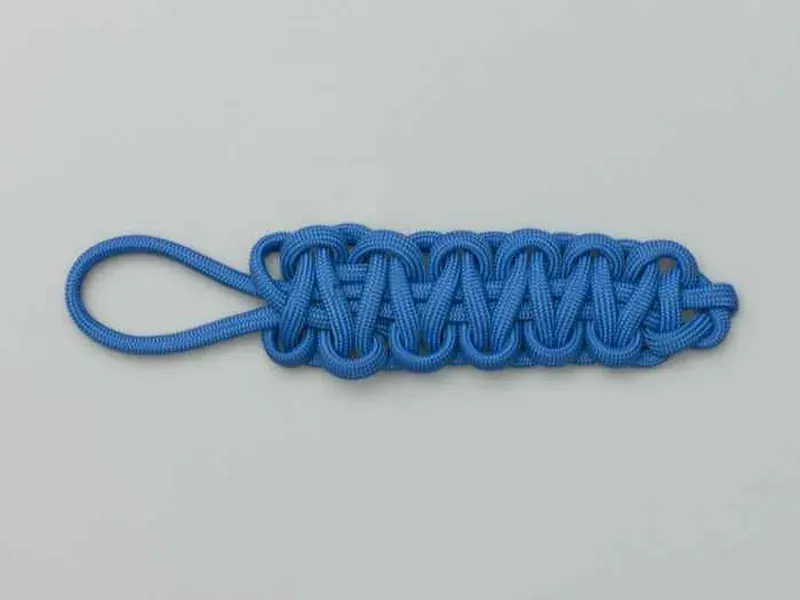
Makes a flat braid by tying square knots one after another with the two outer strands around a two-strand core; it is used in lanyards, military shoulder lanyards and macramé patterns.
Hold the two middle strands taut and side by side as the core; the two strands you will tie with lie to their left and right.
Tie a half knot round the core with the two outer strands: the left strand goes OVER the front of the core to the right, the right strand goes BEHIND the core to the left and comes out through the loop left by the left strand; pull it snug.
Tie the second half knot the other way: the strand that went in front in the first step (now on the right) again goes OVER the front of the core and the other strand goes BEHIND it; the two half knots together make a square knot.
Repeat the two half knots in turn, pushing each new one up against the last, and carry on until the braid is as long as you want.
Keep alternating the half knots so that the braid lies flat; tying the same half knot over and over makes it twist into a spiral.
Braiding lanyards, especially military shoulder lanyards, and making flat bands in macramé.
When
Unknown; it appears as #2496 in Ashley's book of knots (Animated Knots).
Who devised it
Unknown.
Where the name comes from
The sources do not explain the names; the same structure is known as the 'cobra', 'Solomon bar' and 'Portuguese sinnet', and in macramé as the 'square knot' (Animated Knots).
Its story
Animated Knots ranks this braid among the most familiar lanyard knots, found on military shoulder lanyards and throughout macramé work, where it goes by the name 'square knot'. In the macramé chapter of her 'Encyclopedia of Needlework', Thérèse de Dillmont explains its basic unit as the 'flat double knot', with the outer pair of four threads knotted round the inner pair, and sets these knots one under another. An article in the IGKT's Knotting Matters (issue 52, spring 1996) describes the Solomon bar as reef knots stacked one after another on a core of two strands and uses it to make cross shapes in macramé. Animated Knots gives Ashley's number for the structure as #2496.
In load-bearing connections; the sources describe it only as a decorative and lanyard braid.
Weakness
If the half knots are not alternated the braid twists into a spiral instead of lying flat; the length of cord needed is hard to judge, so plenty must be allowed.