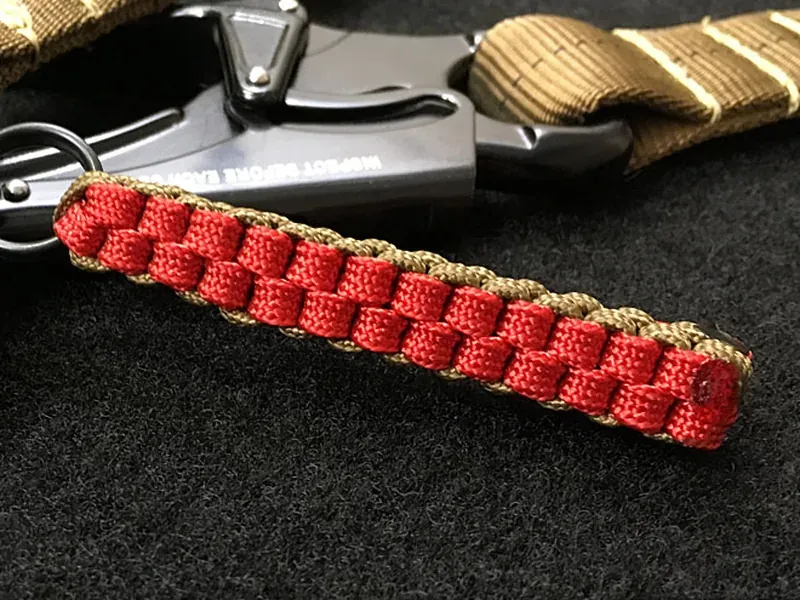
Cross two cords at their midpoints at right angles, or bind four ends together, so that you have four strands.
Lay one strand OVER its neighbour, leaving a bight, and then lay each following strand OVER the previous one, going round in the same direction.
Take the last strand OVER the one before it and tuck it through the bight of the first strand, then pull the strands evenly to tighten the first crown knot.
Following the same rule, tie a new crown knot on top of this one and tighten it; keep going until the braid is as long as you want.
If every crown goes the same way you get a round braid with spiral ridges; if you change direction each time you get the braid known as 'square' or 'box'.
To turn cords or strips into a solid, even lanyard; for decoration, bracelets, straps and cords.
When
Unknown; the oldest descriptions in our sources are Öhrvall (1916) and Verrill (1917).
Who devised it
Unknown.
Where the name comes from
It is made of crown knots stacked one on another; the word 'sinnet' has the variant spellings sennet, sennit and synet (Animated Knots). In Swedish kronplatting (Öhrvall); in Verrill, crown-braid.
Its story
The crown sinnet is a cord braided from crown knots tied one on top of another with the same strands. Öhrvall describes it in 1916 under the Swedish name 'kronplatting': four ends are laid into a crown knot, then crown after crown is added by the same rule, giving a round braid with spiral ridges; he writes that it looks fine but is slow to make, used mostly for decoration, and can also be made with three strands. Verrill, in 1917, calls it the 'crown-braid' and finds it more ornamental than four-strand braiding; it can be made with any number of strands, he says, but a beginner will be content with four or six. According to Animated Knots many people braid it as children with string or coloured plastic; it is likely the most popular choice in lanyard making, known by names such as scoubidou, boondoggle or gimp, and such braids come into fashion now and then as bracelets, anklets or umbrella straps. The version that changes direction each time is called 'square' or 'box', and the one that always goes the same way is called 'barrel'.