Bowline bend TR
Bowline bend, tied and tightened

Bend

Bowline bend

Turkish: İzbarçolu yoma bağı

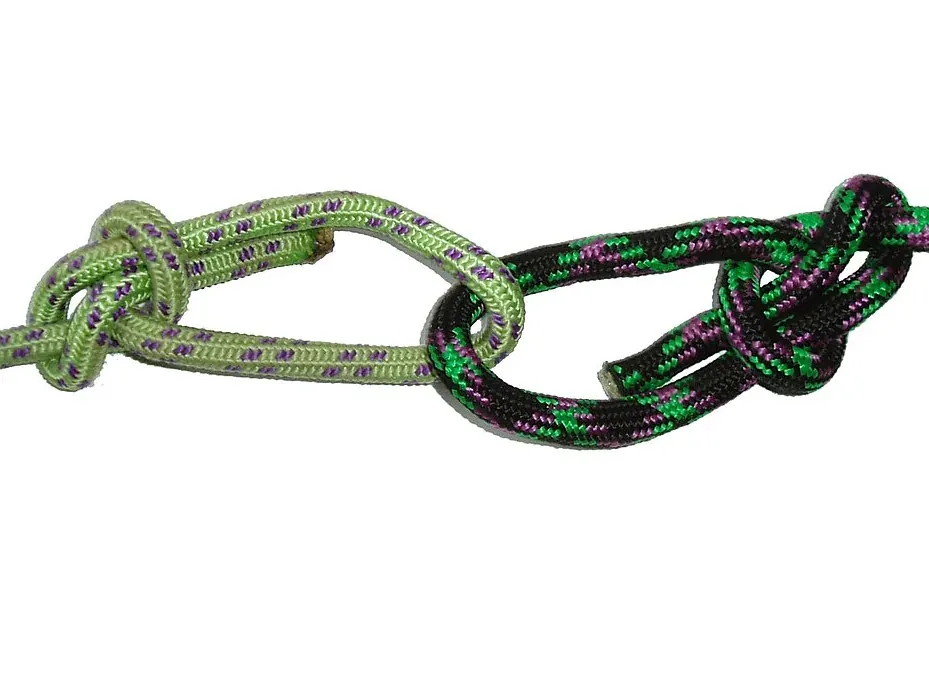
Links two lines with a bowline at the end of each, the eye of one passing through the eye of the other; used especially for heavy lines such as hawsers and for ropes of different thickness, and easy to untie once the load is off.

Medium ABoK 1455 Sailing and boatingLoads and everyday jobs

The animation and practice area for this knot are not ready yet. Available now: Overhand knot, Figure-eight knot, Double overhand knot, Stevedore knot, Ashley's stopper knot, Heaving line knot, Monkey's fist, Slip knot, Sheet bend, Double sheet bend, Carrick bend, Fisherman's knot, Double fisherman's knot, Water knot, Flemish bend (figure-eight bend), Offset overhand bend, Zeppelin bend, Hunter's bend, Butterfly bend, Blood knot (barrel knot), Albright special, Nail knot, Harness bend, Heaving line bend, Racking bend, Reever knot, Simple Simon over, Beer knot, Adjustable bend, Bowline, Double bowline, Water bowline, Bowline on a bight, Spanish bowline, Yosemite bowline, Cowboy bowline, Running bowline, Eskimo bowline, Figure-eight loop, Directional figure eight, Double figure-eight loop, Figure-of-nine loop, Alpine butterfly loop, Overhand loop, Angler's loop (perfection loop), Dropper loop, Farmer's loop, Artillery loop (manharness knot), Fireman's chair knot, Honda knot, Zeppelin loop, Bimini twist, Clove hitch, Slipped clove hitch, Cow hitch (lark's head), Half hitch, Two half-hitches, Round turn and two half-hitches, Anchor bend (fisherman's bend), Timber hitch, Killick hitch, Rolling hitch, Magnus hitch, Taut-line hitch, Buntline hitch, Cleat hitch, Highwayman's hitch, Tumble hitch, Mooring hitch, Halter hitch, Pile hitch, Constrictor knot, Strangle knot, Trucker's hitch, Siberian hitch, Marlinespike hitch, Pipe hitch, Tensionless hitch, Munter hitch, Cat's paw, Ground-line hitch, Becket hitch, Halyard bend, Lobster buoy hitch, Barrel hitch, Bale sling hitch, Swing hitch, Prusik knot, Klemheist knot, Bachmann knot, Autoblock (French prusik), Blake's hitch, Distel hitch, Adjustable grip hitch, Reef knot (square knot), Granny knot, Thief knot, Miller's knot, Packer's knot, Boa knot, Transom knot, Sheepshank, Chain sinnet, Square lashing, Diagonal lashing, Shear lashing, Common whipping, Sailmaker's whipping, Improved clinch knot, Palomar knot, Uni knot, Trilene knot, Arbor knot, Turle knot, Turk's head knot, Carrick mat, Wall and crown knot, Matthew Walker knot, Diamond knot, Chinese button knot, Celtic button knot, Pan Chang knot, Good luck knot, True lover's knot, Friendship knot.

How to tie it

  1. Tie a bowline with an eye of the size you want in the end of the first rope and tighten it.
  2. In the standing part of the second rope, make a small loop with the working end lying OVER the standing part, as in the first step of a bowline.
  3. Lead the second rope's working end through the eye of the first bowline.
  4. Bring the same working end UP through its own small loop from UNDER it, take it round BEHIND its own standing part and back down through the small loop to complete the second bowline.
  5. Tighten the second bowline, then pull on both standing parts to set the bend; the two eyes stay linked through each other.

The method was checked against: R. H. Dana, The Seaman's Friend (5. baskı, 1847), s. 50: A bowline bend (Gutenberg #40958), MEB MEGEP, Denizcilik: Gemici Bağları modülü, s. 31, 5.1.3.3 İzbarçolu yoma bağı, Şekil 5.3, Knots 3D: Bowline Bend (ABoK #1455).

Origin and story

Why it was needed
Joining hawsers and other long ropes so that they can be parted again without trouble after the strain comes off.
When
Unknown; according to Knots 3D, Ashley traces it to Dana's The Seaman's Friend, first published in 1841; it is described in the 1847 edition.
Who devised it
Unknown; according to Knots 3D, Ashley traces the knot to R. H. Dana's book.
Where the name comes from
The name describes its make-up: a bend made of two bowlines; Aldridge also says it is formed of two bowlines. In MEB and KÜRE it is 'izbarçolu yoma bağı'.

Its story

The bowline bend joins two lines by tying a bowline at the end of each and linking the two eyes like the links of a chain. Dana, in 1847, gives it as the most usual way of joining warps and other long or heavy ropes; according to Knots 3D, Ashley catalogues the knot as number 1455 and traces it to Dana's The Seaman's Friend, first published in 1841. The Turkish Ministry of Education (MEB) seamanship module and the KÜRE encyclopedia give it under the name 'izbarçolu yoma bağı' and say it is used to join ropes too big to go through hawse-holes and fairleads. Knots 3D notes that, since a bowline holds without slipping and does not jam under load, this join can be cast off easily once the strain is off, and that it also joins ropes of different thickness and material.

Source: A. F. Aldridge, Knots: A Study of Marlinespike Seamanship (1918), s. 47–48: Bowline Bend (Gutenberg #78376), R. H. Dana, The Seaman's Friend (5. baskı, 1847), s. 50: A bowline bend (Gutenberg #40958), Knots 3D: Bowline Bend (ABoK #1455), MEB MEGEP, Denizcilik: Gemici Bağları modülü, s. 31, 5.1.3.3 İzbarçolu yoma bağı, Şekil 5.3, KÜRE Ansiklopedisi: Gemici Bağları, İzbarçolu Yoma Bağı.

Turkish names, by who uses them

  • Seafarers: İzbarçolu yoma bağı

Main Turkish name from seafarers · MEB, KÜRE (Deniz Harp Okulu)

Sources for the names
Where not to use it
For a lasting join that is kept loaded for long periods; the place where the two eyes cross chafes and wears (Knots 3D).
Weakness
It can be no stronger than the less reliable of the two bowlines and carries the bowline's weaknesses; the eyes rub on each other at right angles and wear at that spot.
Similar and alternative knots

Sources and verification

  • The card was written in our own words from Wikipedia and Wikidata data; the tying method has not yet been checked against two sources.