Alternate ring hitching TR
Alternate ring hitching, tied and tightened

Decorative

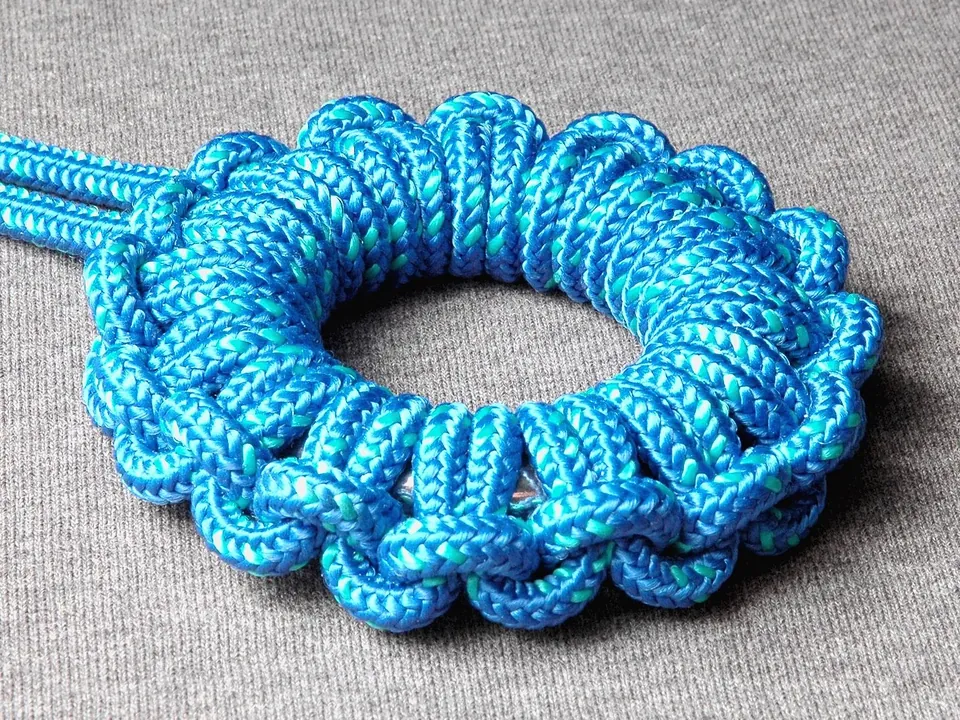
Alternate ring hitching

Covers a ring with half hitches taken alternately left and right; the hitches form a ridge of lark's heads round the ring's outer edge, protecting and decorating the ring.

Medium ABoK 3604 Sailing and boatingDecoration and macramé

The animation and practice area for this knot are not ready yet. Available now: Overhand knot, Figure-eight knot, Double overhand knot, Stevedore knot, Ashley's stopper knot, Heaving line knot, Monkey's fist, Slip knot, Sheet bend, Double sheet bend, Carrick bend, Fisherman's knot, Double fisherman's knot, Water knot, Flemish bend (figure-eight bend), Offset overhand bend, Zeppelin bend, Hunter's bend, Butterfly bend, Blood knot (barrel knot), Albright special, Nail knot, Harness bend, Heaving line bend, Racking bend, Reever knot, Simple Simon over, Beer knot, Adjustable bend, Bowline, Double bowline, Water bowline, Bowline on a bight, Spanish bowline, Yosemite bowline, Cowboy bowline, Running bowline, Eskimo bowline, Figure-eight loop, Directional figure eight, Double figure-eight loop, Figure-of-nine loop, Alpine butterfly loop, Overhand loop, Angler's loop (perfection loop), Dropper loop, Farmer's loop, Artillery loop (manharness knot), Fireman's chair knot, Honda knot, Zeppelin loop, Bimini twist, Clove hitch, Slipped clove hitch, Cow hitch (lark's head), Half hitch, Two half-hitches, Round turn and two half-hitches, Anchor bend (fisherman's bend), Timber hitch, Killick hitch, Rolling hitch, Magnus hitch, Taut-line hitch, Buntline hitch, Cleat hitch, Highwayman's hitch, Tumble hitch, Mooring hitch, Halter hitch, Pile hitch, Constrictor knot, Strangle knot, Trucker's hitch, Siberian hitch, Marlinespike hitch, Pipe hitch, Tensionless hitch, Munter hitch, Cat's paw, Ground-line hitch, Becket hitch, Halyard bend, Lobster buoy hitch, Barrel hitch, Bale sling hitch, Swing hitch, Prusik knot, Klemheist knot, Bachmann knot, Autoblock (French prusik), Blake's hitch, Distel hitch, Adjustable grip hitch, Reef knot (square knot), Granny knot, Thief knot, Miller's knot, Packer's knot, Boa knot, Transom knot, Sheepshank, Chain sinnet, Square lashing, Diagonal lashing, Shear lashing, Common whipping, Sailmaker's whipping, Improved clinch knot, Palomar knot, Uni knot, Trilene knot, Arbor knot, Turle knot, Turk's head knot, Carrick mat, Wall and crown knot, Matthew Walker knot, Diamond knot, Chinese button knot, Celtic button knot, Pan Chang knot, Good luck knot, True lover's knot, Friendship knot.

How to tie it

  1. Secure the working end to the ring: tie a half knot round the ring, or lash the end firmly to it some other way.
  2. Take a half hitch round the ring with the working end, leave the short end trapped under it, and pull the hitch tight.
  3. Make the following half hitch the other way round and pull it tight too.
  4. Keep reversing the direction with every hitch, keeping the ridge of lark's heads along the middle of the ring's outer edge.
  5. When five or six hitches remain, lay a bight of small line on the work with its eye toward the end, and make the last hitches over it.
  6. Pass the working end through that bight and pull the small line to draw the end back under the last hitches.

The method was checked against: Ropeworks: Ringbolt Hitching (Knotboard of the Month), Frayed Knot Arts (Vince Brennan): Single Line Simple Reverse Coxcomb.

Origin and story

Why it was needed
Covering a ring so that ropes running through it do not chafe on the iron and the ring does not clang against things around it; it is also done for decoration.
When
Unknown; listed in Ashley's 1944 book as number 3604 (Wikipedia).
Who devised it
Unknown.
Where the name comes from
From the hitches being taken alternately left and right; the names kackling and keckling are also used.

Its story

Covering a ring with a series of half hitches is called ringbolt hitching; Wikipedia singles out the form in which the hitches go alternately left and right as 'alternate ring hitching', also called kackling or keckling. Ropeworks explains that in this form the hitches lock together as lark's heads (cow hitches), raising a ridge along the outer edge of the ring, and that the covering was used to keep ropes from wearing where they ran through iron rings forged by hand, and to stop the rings from clanging against things nearby. Frayed Knot Arts says the same single-strand series is used to cover the rim of the steering wheel on sailing vessels, particularly steel wheels, and for decoration. Wikipedia also says that keckling was put round oar handles so they would not make noise during covert night operations, but it bases this on a novel.

Source: Wikipedia: Ringbolt hitching, Ropeworks: Ringbolt Hitching (Knotboard of the Month), Frayed Knot Arts (Vince Brennan): Single Line Simple Reverse Coxcomb.

No sourced Turkish name yet.

Where not to use it
For tying anything or carrying a load, and in wet outdoor places; Frayed Knot Arts finds it better suited to indoor work because it is hard to seal fully against water.
Weakness
It needs a steady hand: Frayed Knot Arts notes that the pull changes direction with every hitch and most people favour their stronger hand; unless the hitches are drawn up evenly and the ridge of lark's heads is kept centred, the work wanders.
Similar and alternative knots

Sources and verification

  • The card was written in our own words from Wikipedia and Wikidata data; the tying method has not yet been checked against two sources.