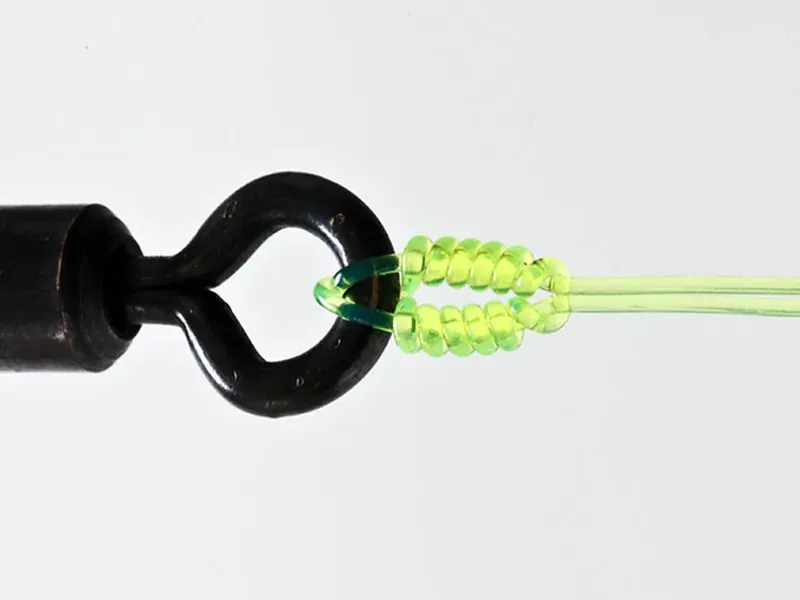
In offshore fishing, ties a double line (made with a knot such as the Bimini twist) very strongly to a heavy-duty swivel or a hook; should one leg part, the other is likely to hold.
Tying a double line very strongly to a swivel or a hook for big-game fishing, so that if one leg breaks the other still holds.
When
Unknown; no date appears in the sources.
Who devised it
Unknown; according to NetKnots the twisted form is recommended by Lefty Kreh and Geoff Wilson.
Where the name comes from
Unknown; the sources do not explain the name. Geoff Wilson and FishTrack also call the same knot the Cat's Paw.
Its story
The offshore swivel knot is used in offshore fishing to tie a double line to a heavy-duty swivel or a hook, often together with the Bimini twist that makes the double line; according to NetKnots, its best-known selling point is that the second leg will likely keep holding if the first one parts. NetKnots writes that the version in which the loop is given a twist before it is folded back over the swivel is the way favoured by Lefty Kreh, a famous name in fly fishing, and by Geoff Wilson, a well-known Australian guide to saltwater fishing, and that Wilson calls this twisted form the 'Cat's Paw'. On FishTrack, Steve Dougherty also describes the knot under that name and says five passes are enough with 50-pound monofilament. In NetKnots' own tests, the untwisted true cat's paw stayed slightly more stable when one leg of the double line was cut.
On a single strand of line; the knot is tied with the loop at the end of the line.
Weakness
If the swivel is passed through the loop too many times the knot is hard to cinch and does not seat properly; the twisted and untwisted forms behave differently when one leg is cut, and in NetKnots' tests the untwisted form stayed slightly more stable.