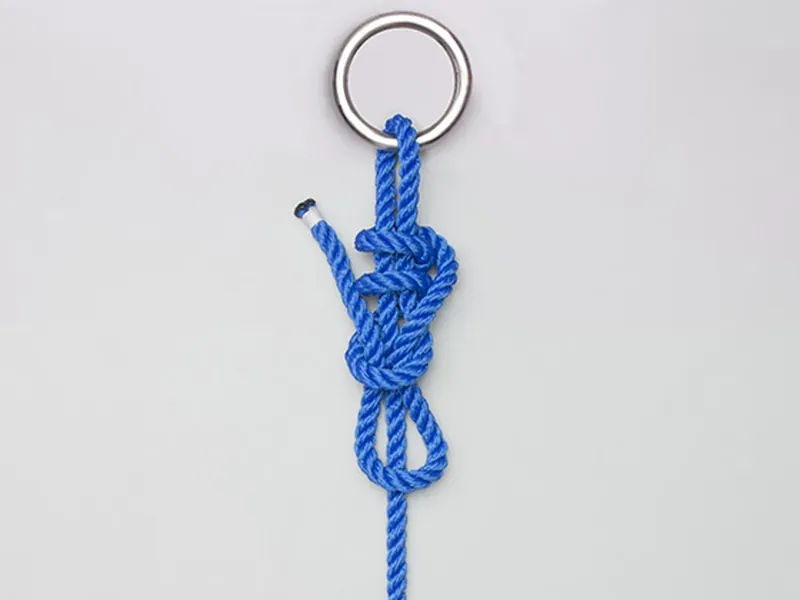
Pass the working end through the ring and bring it down beside the standing part.
Cross the working end OVER the standing part to make a loop, then take it UNDER both the standing part and its own descending leg.
Keep wrapping round these two legs above the loop, working up towards the ring, until there are two turns in all (the pass behind them starts the first).
Double the end into a bight and push that bight down through the loop, leaving the end itself outside.
Pull the standing part to tighten; to untie, pull the end to free the bight, unwind the turns and draw the rope back out of the ring.
Tying drooling cows to a ring or post in the barn with a hitch that does not jam when wet and unties easily.
When
Unknown; Ashley describes it in The Ashley Book of Knots in 1944 (#242 and #1828).
Who devised it
Unknown; Ashley writes that he came across it in rural Delaware.
Where the name comes from
The sources do not explain where the name comes from.
Its story
Clifford W. Ashley includes the manger hitch twice in The Ashley Book of Knots (#242 and #1828). He explains that a cow slobbers all the time, so she ought to be tied with a hitch that stays free of jamming even when soaked; he says he came across this one in rural Delaware and that, although wet knots are usually a struggle to untie, it practically never jams, and he adds the wry remark that halters had become rare in cow barns. Knots 3D writes that the hitch was traditionally used on dairy farms to tie cows in their stalls, and that it also serves in camping and outdoor work as a temporary attachment that unties easily.
Where the fastest possible release is needed, such as freeing a panicking horse; the sources recommend the halter hitch for that.
Weakness
The wrapping turns slow the release a little and the rope has to be drawn back out of the ring, so it does not let go as instantly as other quick-release hitches.