Knute hitch TR
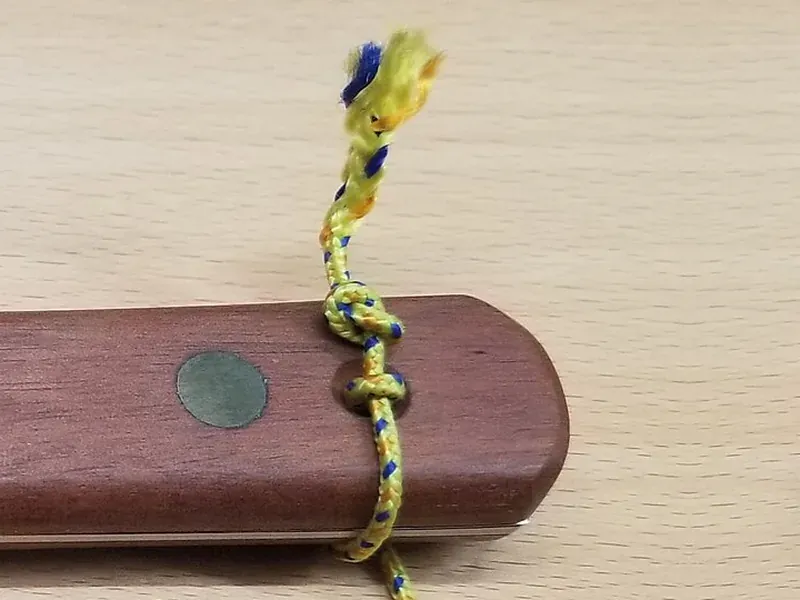
Knute hitch, tied and tightened

Hitch

Knute hitch

Fastens a thin lanyard to the hole in the handle of a knife, marlinspike or other tool, so the tool stays on the line if it slips out of your hand.

Easy No ABoK number Sailing and boatingLoads and everyday jobs

The animation and practice area for this knot are not ready yet. Available now: Overhand knot, Figure-eight knot, Double overhand knot, Stevedore knot, Ashley's stopper knot, Heaving line knot, Monkey's fist, Slip knot, Sheet bend, Double sheet bend, Carrick bend, Fisherman's knot, Double fisherman's knot, Water knot, Flemish bend (figure-eight bend), Offset overhand bend, Zeppelin bend, Hunter's bend, Butterfly bend, Blood knot (barrel knot), Albright special, Nail knot, Harness bend, Heaving line bend, Racking bend, Reever knot, Simple Simon over, Beer knot, Adjustable bend, Bowline, Double bowline, Water bowline, Bowline on a bight, Spanish bowline, Yosemite bowline, Cowboy bowline, Running bowline, Eskimo bowline, Figure-eight loop, Directional figure eight, Double figure-eight loop, Figure-of-nine loop, Alpine butterfly loop, Overhand loop, Angler's loop (perfection loop), Dropper loop, Farmer's loop, Artillery loop (manharness knot), Fireman's chair knot, Honda knot, Zeppelin loop, Bimini twist, Clove hitch, Slipped clove hitch, Cow hitch (lark's head), Half hitch, Two half-hitches, Round turn and two half-hitches, Anchor bend (fisherman's bend), Timber hitch, Killick hitch, Rolling hitch, Magnus hitch, Taut-line hitch, Buntline hitch, Cleat hitch, Highwayman's hitch, Tumble hitch, Mooring hitch, Halter hitch, Pile hitch, Constrictor knot, Strangle knot, Trucker's hitch, Siberian hitch, Marlinespike hitch, Pipe hitch, Tensionless hitch, Munter hitch, Cat's paw, Ground-line hitch, Becket hitch, Halyard bend, Lobster buoy hitch, Barrel hitch, Bale sling hitch, Swing hitch, Prusik knot, Klemheist knot, Bachmann knot, Autoblock (French prusik), Blake's hitch, Distel hitch, Adjustable grip hitch, Reef knot (square knot), Granny knot, Thief knot, Miller's knot, Packer's knot, Boa knot, Transom knot, Sheepshank, Chain sinnet, Square lashing, Diagonal lashing, Shear lashing, Common whipping, Sailmaker's whipping, Improved clinch knot, Palomar knot, Uni knot, Trilene knot, Arbor knot, Turle knot, Turk's head knot, Carrick mat, Wall and crown knot, Matthew Walker knot, Diamond knot, Chinese button knot, Celtic button knot, Pan Chang knot, Good luck knot, True lover's knot, Friendship knot.

How to tie it

  1. Put a stopper, such as a figure-eight knot, in the working end of the lanyard.
  2. Double the cord into a bight and push that bight into the tool's hole until it sticks out on the far side.
  3. Pass the working end, with its stopper, through the bight sticking out on the far side of the hole.
  4. Pull the standing part to draw the bight back into the hole; the bight jams the end in the mouth of the hole and the stopper keeps it from escaping.

The method was checked against: Gregg Nestor, "Lots and lots of knots", Good Old Boat, sayı 36 (Mayıs/Haziran 2004): Knute hitch, fotoğraf dizisi 1–3, NetKnots: Knute Hitch (çizim: John E. Sherry, 2016).

Origin and story

Why it was needed
Tying knives, marlinspikes and similar tools to a thin line so they are not dropped, or lost overboard from a boat.
When
Unknown; the sources believe the hitch is much older than its name. Brion Toss named it in 1990 (Good Old Boat); Wikipedia cites Toss's 1992 book The Rigger's Locker for the naming.
Who devised it
Unknown; it was named by the rigger Brion Toss.
Where the name comes from
Brion Toss took the name from Knute, his favourite marlinspike.

Its story

The Knute hitch is a small hitch that fastens a thin lanyard to the hole in the handle of a knife, marlinspike or other hand tool; if the tool slips from your hand it stays on the line, and aboard a boat it does not go overboard. Its name comes from the rigger Brion Toss, who called it after Knute, his favourite marlinspike. Gregg Nestor, writing in Good Old Boat in 2004, dates the naming to 1990, while Wikipedia points to Toss's book The Rigger's Locker, published in 1992. The sources add that the hitch itself is probably much older than its name; Nestor thinks it has likely been known for centuries and notes that flags, and even sails, can be fastened to their halyards with it too.

Source: Wikipedia: Knute hitch, Gregg Nestor, "Lots and lots of knots", Good Old Boat, sayı 36 (Mayıs/Haziran 2004): Knute hitch, fotoğraf dizisi 1–3, NetKnots: Knute Hitch (çizim: John E. Sherry, 2016).

No sourced Turkish name yet.

Where not to use it
With cord too thick to pass doubled through the hole, or on objects whose hole is much wider than twice the cord's diameter; if the bight does not jam in the hole, the hitch does not hold.
Weakness
Its grip depends on the bight jamming inside the hole and on the stopper in the end; it reduces the strength of the cord (Good Old Boat puts its efficiency at about 55 percent).
Similar and alternative knots

Sources and verification