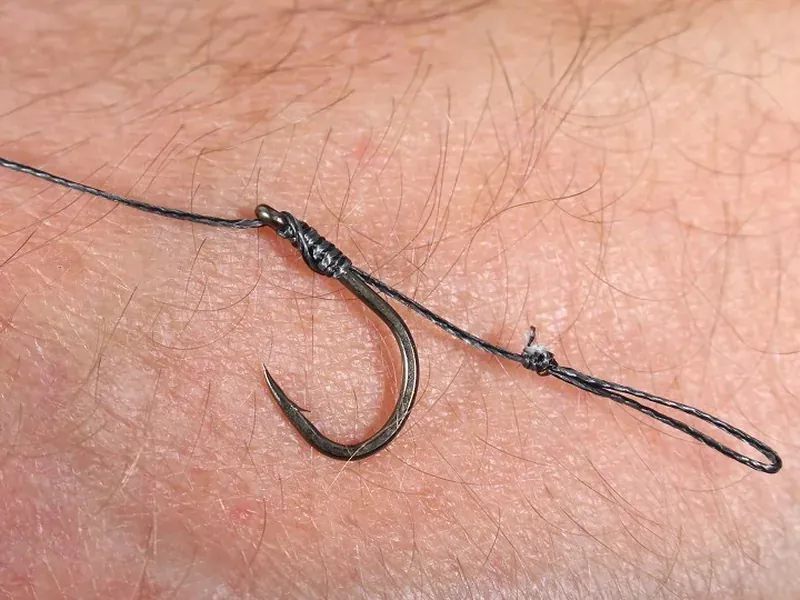
Form a small loop to carry the bait in the end of the line.
Pass the other end into the eye of the hook from behind, so it emerges on the point side.
Slide the line through the eye until the bait loop sits as far beyond the hook's bend as you want.
Holding the hanging line against the shank, wrap the working end tightly and neatly around the shank and that line, working from the eye toward the bend; NetKnots suggests 5–8 wraps and Carpology 7–9 (the count depends on the hook).
After the last wrap, pass the working end through the eye once more, again from the back.
Keeping the loop in place, pull the working end and work the wraps up snug against the eye.
Tying an eyed hook to the line while leaving a hanging length of line to carry the bait, so the bait sits apart from the hook and the point stays clear.
When
Unknown; Wikipedia says the hair rig it is used in became popular in the 1980s.
Who devised it
Unknown; Wikipedia credits the hair rig itself to Len Middleton and Kevin Maddocks.
Its story
This knot belongs to the hair rig used by carp anglers: the bait sits not on the hook but on a short length of line, the hair, hanging below it, so the hook point stays clear and the fish feels no hook at the instant it picks up the bait. Wikipedia dates the spread of the hair rig to the 1980s and names Len Middleton and Kevin Maddocks as its joint inventors; its name comes from the human hair used to hold the bait in their first trials. NetKnots describes the knot as a favourite with carp anglers and notes that the rig tends to hook the fish by itself.