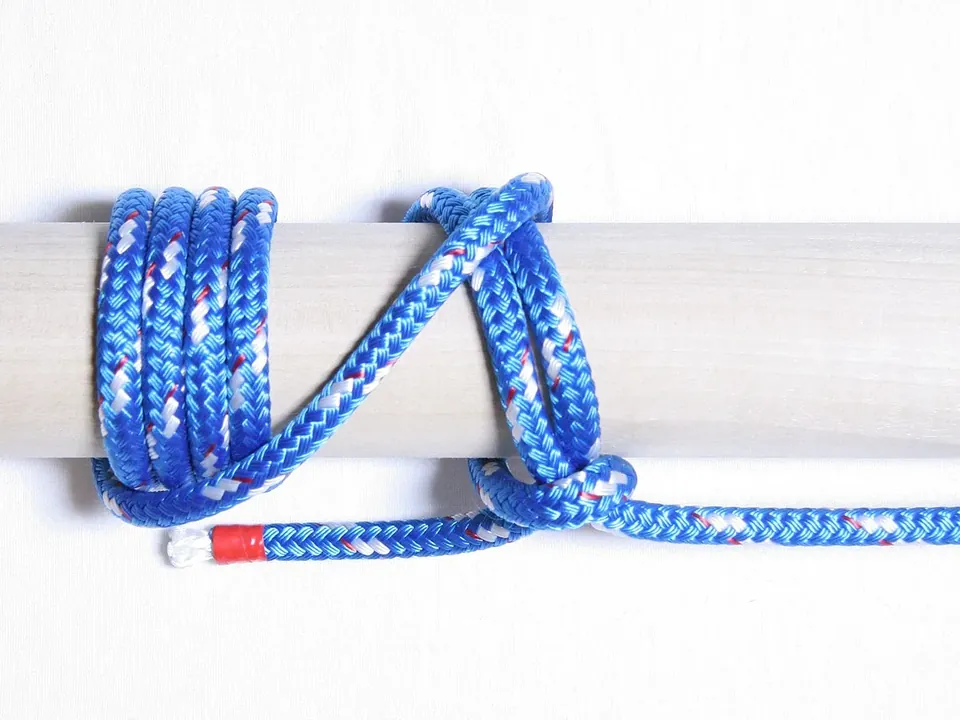
Wrap the working end round the pole four or five times, moving away from the end of the pole and from the direction of pull.
Leave a large bight hanging behind the pole and bring the working end back over the pole beside the standing part.
Bring the bight round both ends and put it over the end of the pole (the sources differ on whether the bight passes in front of the ends or behind them).
Tighten by pulling both ends at right angles to the pole.
Load it parallel to the pole, from the right direction.
Gripping a slippery, tapering pole without slipping, even under a pull parallel to it.
When
Unknown; the sources give no date.
Who devised it
Unknown.
Where the name comes from
From the claim that it would hold even on a tapered belaying pin (an icicle).
Its story
The icicle hitch holds without slipping on a smooth surface even under a one-way pull parallel to the pole; its name comes from the claim that it would hold even on a tapered belaying pin. It closely resembles Ashley's knot number 1762 for hoisting a spar, and the klemheist. In a 2009 comparison by Practical Sailor it was found better than the other friction hitches, including the rolling hitch.