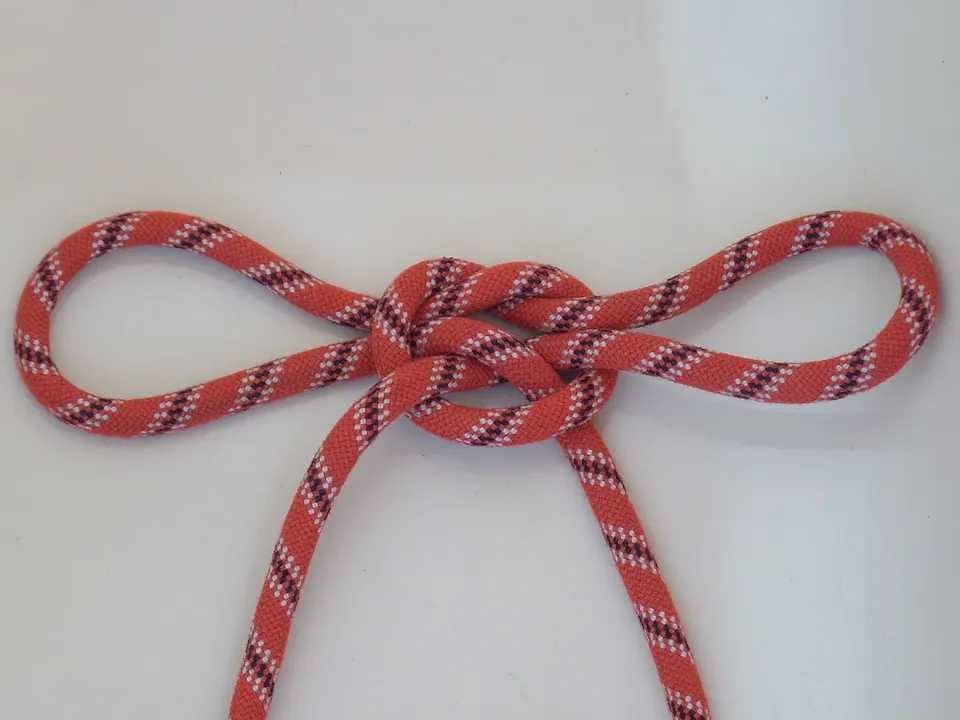
Makes two adjustable loops in the middle of a rope that face in opposite directions and close when the ends are pulled; used to hobble horses, to tether an animal or haul a carcass and, when there is no other way, to pull a trapped person out by the wrists.
MediumABoK 1134, 1140Search and rescueLoads and everyday jobs
Life safety: This knot is used in climbing, rescue or tree work. This app does not replace hands-on training; for life-safety work, practise under an instructor.
In the middle of the rope, make two identical loops turning the same way and lay them side by side.
Overlap the loops partly, as if starting a clove hitch, so that the left side of the right loop lies inside the left loop and the right side of the left loop lies inside the right loop.
Take the side of each loop that lies inside the other loop and pull it out through the other loop; this forms a loop on each side.
Tighten the knot in the middle and bring the loops to the size you need; pulling the ends closes the loops.
To stop the loops from slipping, tie the two ends to each other with an overhand knot or more, reef-knot fashion.
Holding the wrists or feet of a person or an animal in two adjustable loops: hobbling horses, pulling a trapped person out by the wrists.
When
Unknown; Ashley describes it in The Ashley Book of Knots (#1134) for use as a handcuff.
Who devised it
Unknown.
Where the name comes from
Ashley described it for use as a handcuff (Animated Knots); the name hobble knot comes from its use on horses' legs (Wikipedia, Knots 3D).
Its story
The handcuff knot is tied in the bight in the middle of a rope and gives two adjustable loops facing in opposite directions. According to Animated Knots, Ashley described it for use as a handcuff (ABoK #1134), but the knot barely locks by itself, so it falls short of what its name promises. Its other name, hobble knot, comes from cowboys tying it on the legs of horses so that they did not have to walk far to fetch them in the morning. In search and rescue it is generally avoided because it can injure the person; but if someone trapped in a crevice or a hole cannot be freed any other way, the loops can be put around their wrists or ankles and the rope pulled, and if each end is used to put a half hitch around the neck of the loop beside it, fixing the loop sizes, it becomes the fireman's chair knot.
As a real handcuff, since it has no locking action of its own, and in any rescue where proper rescue equipment can be used.
Weakness
Unless the ends are tied together the loops slip; pulling a person by the wrists or ankles can injure them, and this app does not replace hands-on training.