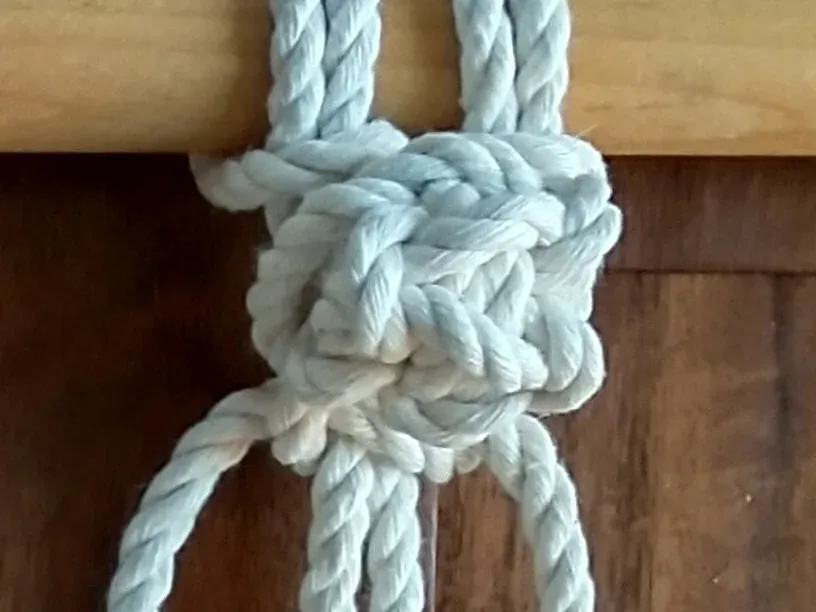
A round, raised ornamental knot in macramé, made by rolling up a short run of square knots; it adds an accent to a piece and can be tied in a different colour to stand out.
Work with four cords: the two middle ones are the filler cords and the two outer ones are the knotting cords.
With the outer cords, tie 3–4 square knots in a row around the filler cords (each is two half knots tied in opposite directions); the number of knots sets the size of the berry.
Lift the two filler cords up over the front of the row and pass them through the gap in the middle at the top of the first knot; if there is no room, loosen the knots a little.
Pull the filler cords downward so that the row of knots rolls up into a round berry.
Keeping the filler cords tight, tie one more knot just below the berry to secure it.
To add a round, raised ornament and accent to macramé work; an example of combining several knots to get a new shape.
When
Unknown; no date appears in the sources.
Who devised it
Unknown.
Where the name comes from
The sources do not explain the name; they refer to the finished round knot as a 'berry'.
Its story
Say you are making a cotton plant hanger and want a small, round accent that catches the eye between the flat rows of knots. With four cords you tie three or four square knots, pass the two middle cords through the top of the row and pull them down, and the knots roll up into a little berry. One more knot underneath holds it in place; if you like, you can make it in a different colour so that it stands out.
As a knot that holds something or takes a load; it is purely decorative.
Weakness
Without a securing knot underneath, or if the filler cords are not kept tight, the berry unrolls back into a flat row of knots; if the square knots are tied too tight, the filler cords cannot be passed through at the top.