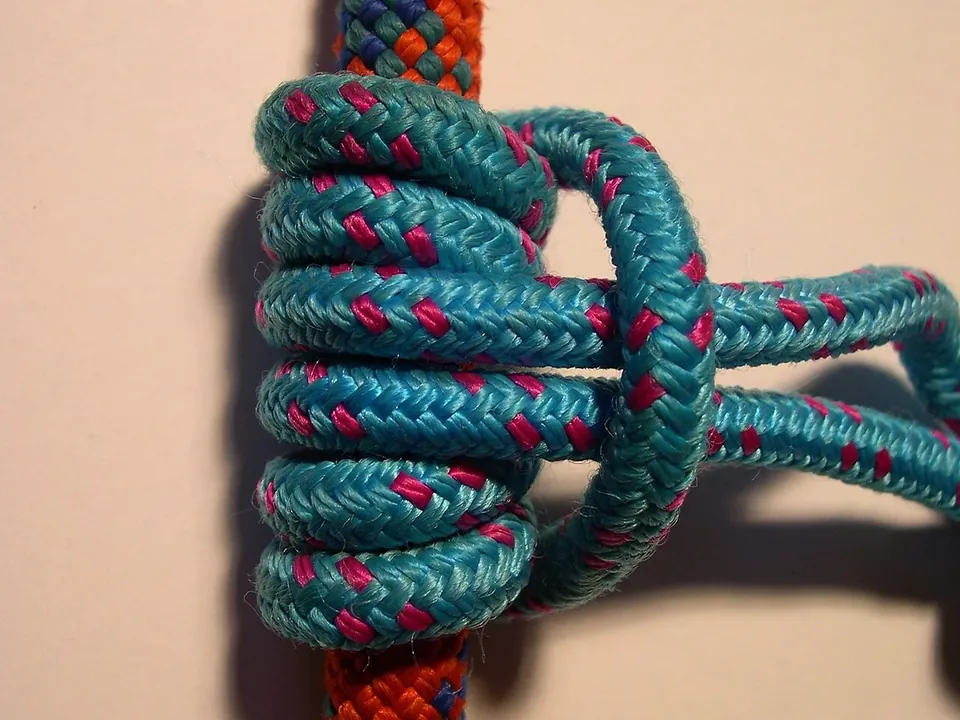
Friction hitch
Prusik knot
Turkish: Prusik düğümü
Wraps a thin cord loop around a main rope to make a grip that slides when unloaded and locks under load.
Life safety: This knot is used in climbing, rescue or tree work. This app does not replace hands-on training; for life-safety work, practise under an instructor.
How to tie it
- The loop is traced as one strand: both legs go down to the carabiner (the double fisherman's knot that closes the loop is far away). Bring one leg to the main rope and pass it OVER (in front of) the main rope.
- Wrap the loop round the main rope working upward: BEHIND (under), IN FRONT (over)… three turns in the upper half.
- Bring the loop down beside the wraps: this bridge goes OVER the leg.
- Make three more turns in the lower half, working upward: BEHIND, IN FRONT… The lower wraps mirror the upper ones; the legs stay in the middle.
- Bring the other leg out UNDER the bridge and down to the carabiner: both legs come out side by side under the bridge.
- Dress the wraps side by side and tighten. It must hold under load and slide by hand when unloaded; never clip the carabiner to the double fisherman's knot.
The method was checked against: Animated Knots: Prusik Knot, Y. Güngör, Dağcılık, İstanbul Üniversitesi AUZEF ders kitabı, s. 111, AFAD, "İpli Kurtarma Hazırlayıcı Eğitimi" (2025), s. 12.
Turkish names, by who uses them
- Climbers: Prusik düğümü
- General use: Prusik düğümü, Üç sargılı pursik
Main Turkish name from climbers · AUZEF Dağcılık
- Where not to use it
- When the cord is too thick or slippery for the main rope.
- Weakness
- Grip changes on wet or icy rope; adjust the number of wraps to the rope.
Similar and alternative knots
Sources and verification
- Wikipedia: Prusik
- Wikidata: Q1348740
- The tying steps were played in the rope engine to produce the checking signature; the comparison with two independent sources is in docs/pilot-baglar.md.