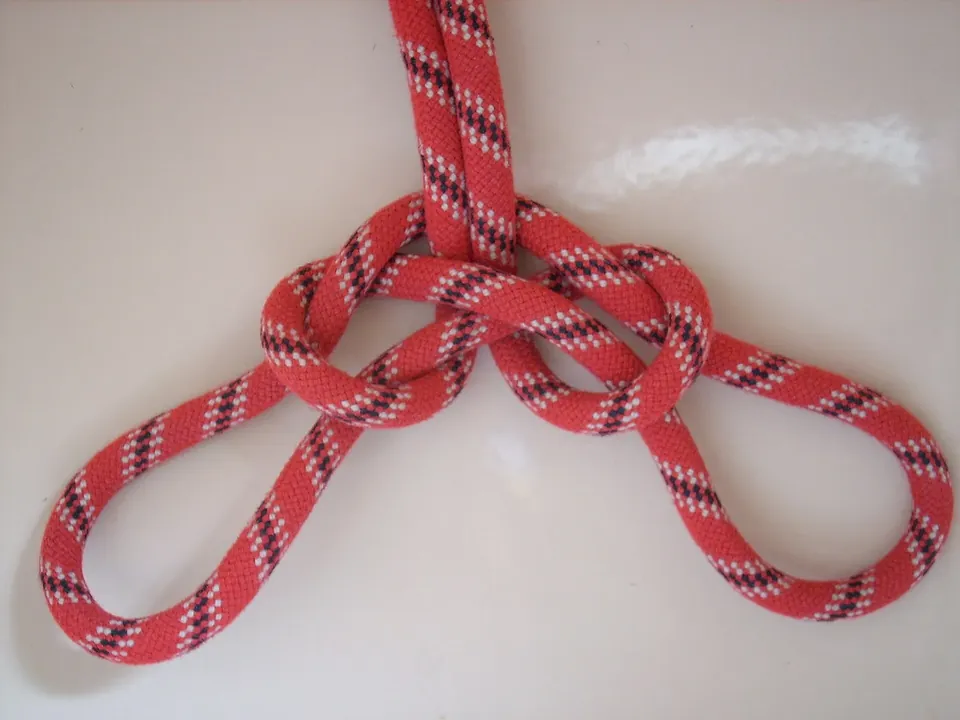
Loop
Spanish bowline
Makes two separate loops in the middle of a rope; once used to lift people in rescue.
Life safety: This knot is used in climbing, rescue or tree work. This app does not replace hands-on training; for life-safety work, practise under an instructor.
How to tie it
- The knot is tied in the middle of the rope; the end traces the left standing part. Lead it up and form the left ear: up, round to the left and down its outer leg.
- The left diagonal: bring the end down to the right OVER the left standing part.
- The right loop: lead the end up, round the top of the loop and down its outside.
- The lower link: take the end to the left UNDER (behind) the left standing part.
- The left loop: lead the end up on the left, into the left ear OVER its outer leg and up UNDER its top; round the top of the loop and come back the same way: UNDER the top, OVER the outer leg.
- The right diagonal: bring the end up to the right OVER the left standing part and UNDER the left diagonal.
- The right ear: lead the end up UNDER both legs of the right loop and round the top of the ear OVER both legs.
- The right standing part: lead the end down UNDER both diagonals and OVER the lower link.
- Pull both loops and both standing parts to draw the knot up hard; if it is left loose, rope can slip from one loop into the other.
The method was checked against: Animated Knots: Spanish Bowline, Wikipedia: Spanish bowline.
No sourced Turkish name yet.
- Where not to use it
- When the loops will not share the load equally.
- Weakness
- If one loop is unloaded the other can slip.
Similar and alternative knots
Sources and verification
- Wikipedia: Spanish bowline
- Wikidata: Q588831
- The tying steps were played in the rope engine to produce the checking signature; the comparison with two independent sources is in docs/pilot-baglar.md.