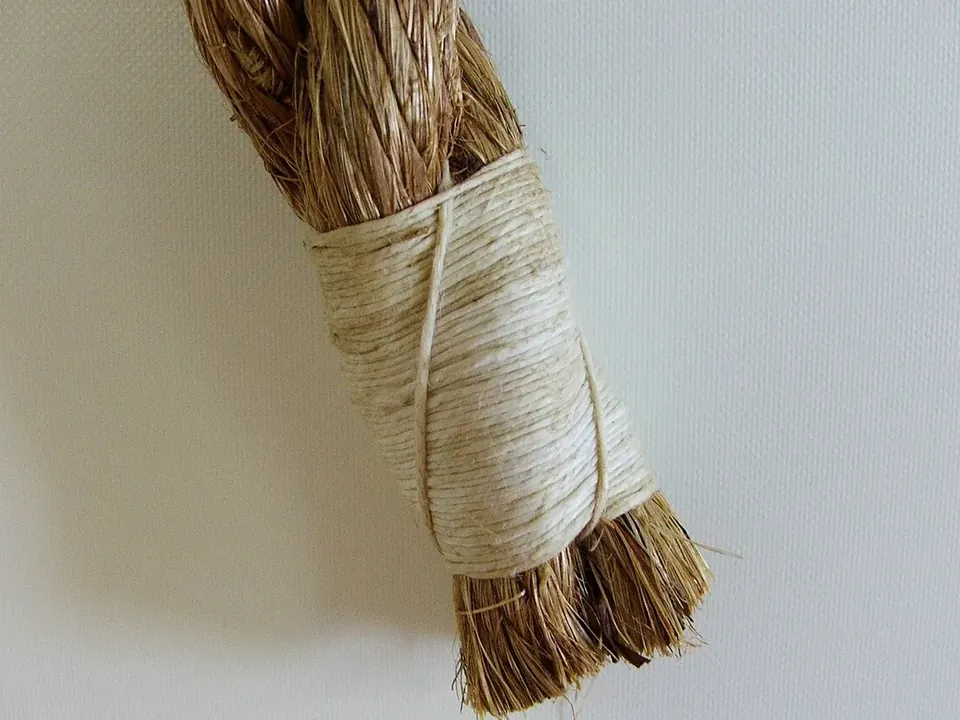
Splices and whippings
Sailmaker's whipping
A very durable end whipping whose turns are fixed to the rope's strands with a needle.
How to tie it
- Unlay the strands a little. Take a bight in the middle of the twine, put it round strand 1, bring both ends out between strands 2 and 3 and lay the strands up again. The bight stays outside as a loop (drawn lying up beside strand 1; in practice it hangs free while you wrap). The short end (A) is finally led up the groove between strands 2 and 3; it is drawn there from the start.
- Wrap the long end (B) toward the rope's end: tight turns side by side, as wide as the rope is thick. The turns go OVER the rope and UNDER the loop's leg; the short end stays outside the turns.
- Open the strands a little, bring the loop up and over the end of strand 1, and pull the short end so the loop beds into the grooves either side of strand 1. In the animation the strand end is passed down UNDER the top of the loop and back up OVER it: only the relative motion matters, the result is the same.
- Bring the long end up between strands 1 and 3 to the end of the rope. Tie the two ends together with a reef knot between the strands (not drawn), push it down between them and trim.
- Tighten
The method was checked against: Animated Knots: Sailmaker's Whipping, Wikipedia: Sailmaker's whipping.
No sourced Turkish name yet.
- Where not to use it
- On braided rope (the needle version is needed there).
- Weakness
- Needs a needle and experience.
Similar and alternative knots
Sources and verification
- Wikipedia: Sailmaker's whipping
- Wikidata: Q7400407
- The tying steps were played in the rope engine to produce the checking signature; the comparison with two independent sources is in docs/pilot-baglar.md.