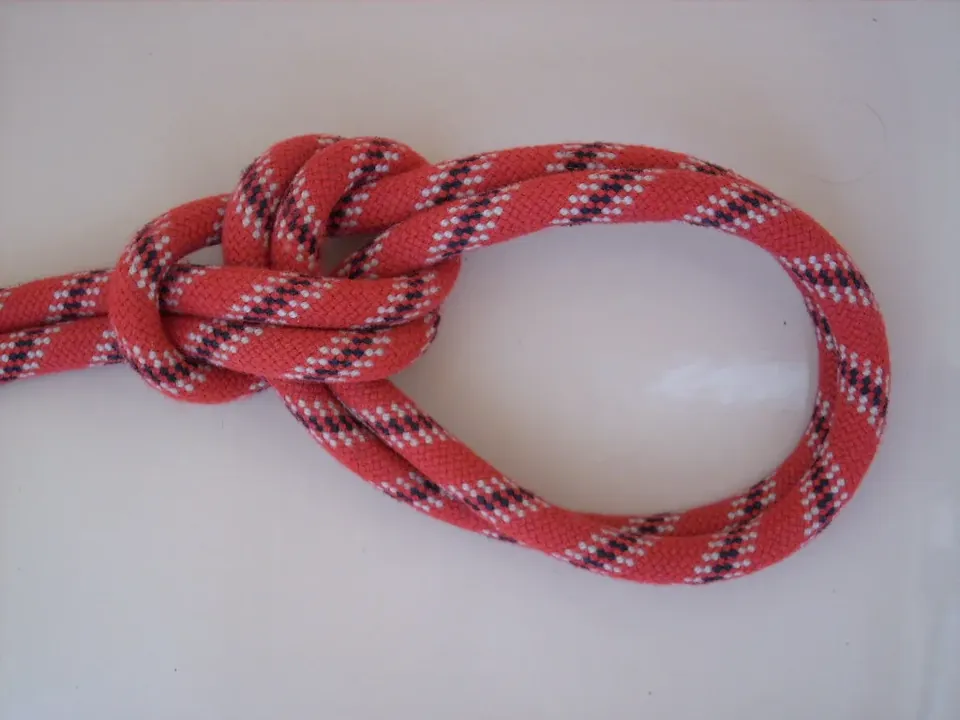
Loop
Bowline on a bight
Turkish: Doblin izbarço bağı
Makes a bowline with two loops in the middle of a rope; also used as a seat in rescue.
Life safety: This knot is used in climbing, rescue or tree work. This app does not replace hands-on training; for life-safety work, practise under an instructor.
How to tie it
- Take a long bight in the middle of the rope and, with the doubled rope, make a small loop in the standing part: the bight crosses OVER it. (The animation draws the two strands of the bight one at a time: first one, and at the end the other back along the same path.)
- Leave enough for the eyes: take the bight down, round, and back up below the loop.
- Push the end of the bight UP through the loop from underneath: UNDER its lower edge, OVER its upper edge. A double eye stays below.
- Open the end of the bight, pass it down over the whole knot and both eyes, and bring it up behind: the bight settles round both standing parts like a collar, its upper side UNDER (behind) them, its lower side OVER them.
- The other strand of the bight always lies beside the first: it goes down through the loop (OVER its upper edge, UNDER its lower edge) and forms the inner eye.
- The other strand doubles the loop too: OVER the standing part, UNDER the two strands through the loop, then OVER them.
- The other strand leaves as the second standing part: UNDER both loops and the lower side of the collar, OVER its upper side.
- Pull the eyes against both standing parts to set the knot; the two eyes can be adjusted to different sizes.
The method was checked against: Animated Knots: Bowline on a Bight, MEB MEGEP, Gemici Bağları modülü (2014), s. 14.
Turkish names, by who uses them
- Seafarers: Doblin izbarço bağı
- Scouts: Doblin izbarço bağı
Main Turkish name from seafarers · MEB, KÜRE (Deniz Harp Okulu)
- Where not to use it
- Where each loop has to take load independently.
- Weakness
- Tied wrong, one of the loops can slip.
Similar and alternative knots
Sources and verification
- Wikipedia: Bowline on a bight
- Wikidata: Q1243406
- The tying steps were played in the rope engine to produce the checking signature; the comparison with two independent sources is in docs/pilot-baglar.md.